


The Humanistic Aspects of Celebrating the Prophet's Birth
09 September, 2025
Portsudan, (Sudanow)_ Muslims across the globe celebrate the birth of Prophet Muhammad (peace be upon him) every year. The festivities begin with the sighting of the crescent moon of the month of Rabi' al-Awwal and continue until the 12th of the month, which marks the Prophet's birthday.
This report aims to highlight the humanistic aspects that accompany the Prophet's birthday celebrations, such as feeding the needy, social solidarity, and love.
This year, the celebrations returned to Hosh al-Khalifa in Omdurman after a two-year hiatus due to the war.
To get a sense of what was happening inside the celebration grounds, Sudanow met with the journalist Awatif Fathal-Rahman, who said: "I feel like this is the first celebration I've ever witnessed in my life. I'm so happy to be here and see these timeless traditions what remind us that our nation is well and recovering. It's true that the festival ground is quieter and less crowded than in previous years, but we are joyous to see life return to what it was before the war."

Awatif added: "The celebrations vary from one place to another around the world. In Sudan, it begins with the Mawlid procession, where Sufi sheikhs and their followers march from their mosques and Zawiyas to the festival grounds. They travel on foot, on horseback, or in cars with blaring horns in celebration. Some play the duff (a type of drum) and tar (tambourine), while others carry flags that represent their Sufi orders. Upon reaching the festival grounds, they all form a large circle called a 'dhikr circle' (remembrance circle)."
The dhikr circle is held on Friday during the Mawlid celebration in Omdurman (Hosh al-Khalifa), or as determined by the participants. Those who engage in dhikr chant and praise Allah with every movement. After the sunset prayer, they prepare for the evening prayer, followed by religious lectures and readings of the Prophet's biography in the form of poetic verses.
After the evening prayer, the tent fills with the sounds of praise-singers expressing their love for the Prophet. At the same time, those in charge of the tent serve food, tea, coffee, and sweets to their visitors. This part of the celebration is what makes street children particularly happy.
The Mawlid feast is one of the most distinguished expressions of humanity at the celebration, as both the Quran and the Prophet's teachings encourage feeding the hungry.
During our tour of the festival grounds, we met a visitor to Hosh al-Khalifa, who told us that he comes every year to enjoy the customary feasts provided by various Sufi followers and charitable people in the country. He wished that the celebration would last all year so that he would never feel hungry again, as this occasion is a chance for him to quiet the hunger he feels throughout the year.
Visitors are always impressed by the tents at the festival. They are four-sided, made of iron poles and fabric walls with beautiful, bright colors like red, green, white, and orange, according to the Sufi order's emblem. It is said that these colors represent the Prophet's clothing and the flags he carried during battles.
The tents are adorned with cheerful, bright lights, lanterns, and pictures of Sufi sheikhs. Sometimes, they also display religious books and prayer beads used for dhikr.
Inside the festival grounds, there are also tents for free medical check-ups, dental clinics, and a small pharmacy that provides first-aid and essential medications free of charge to patients.
The most famous Sufi orders offering this service are the followers of the Burhaniyya order at the festival in Al-Sajjana and the followers of the Sammaniyya order at Hosh al-Khalifa in Omdurman.
Outside the festival grounds, visitors are greeted by sweet shops surrounding the area from all sides. In front of them, vendors display toys and balloons for children. The Mawlid doll and the horse are particularly enticing, so children ask their parents to buy them extra toys.
Mawlid sweets are an essential part of the celebrations for both adults and children. They are traditional sweets that have been made for a long time and come in many types, such as the Mawlid doll (a doll made of sugar and healthy flavors), simsimiyya (sesame candy), fuliyya (peanut candy), homsiyya (chickpea candy), jawziyya (coconut candy), and al-lukum (nougat).
Awatif said: "The price per kilo ranges from 14 to 20 Sudanese pounds, depending on the type of sweet."
Buying these sweets is a fixed ritual of the Mawlid celebration, as every festival has its special sweets, and the celebration of the Prophet's birth must be accompanied by delicious sweets that distinguish its details.
Another aspect of social solidarity in the celebration is the reunion of family and friends at the festival grounds. Safaa al-Nil expressed her joy at seeing her brothers whom she had been too busy to visit. Tasabih Mubarak said that she takes advantage of visiting Hosh al-Khalifa in Omdurman to call her friends and meet with them.
These gatherings continue at the festival grounds until the 12th of Rabi' al-Awwal, the day of the Prophet's birth. After that, they move to the mosques and private Zawiyas of the Sufi orders until the end of Rabi' al-Thani. The reading of the Prophet's biography also continues after the sunset or evening prayers on every night of the month of Rabi'.
Some people consider the Mawlid festival a place for spiritual tourism, dhikr, and an opportunity to get closer to the Prophet's life. Others see it as a place that opens doors for livelihoods, such as the traders of sweets and children's toys. Still, others consider it a season for reuniting with loved ones in the embrace of these fragrant days.
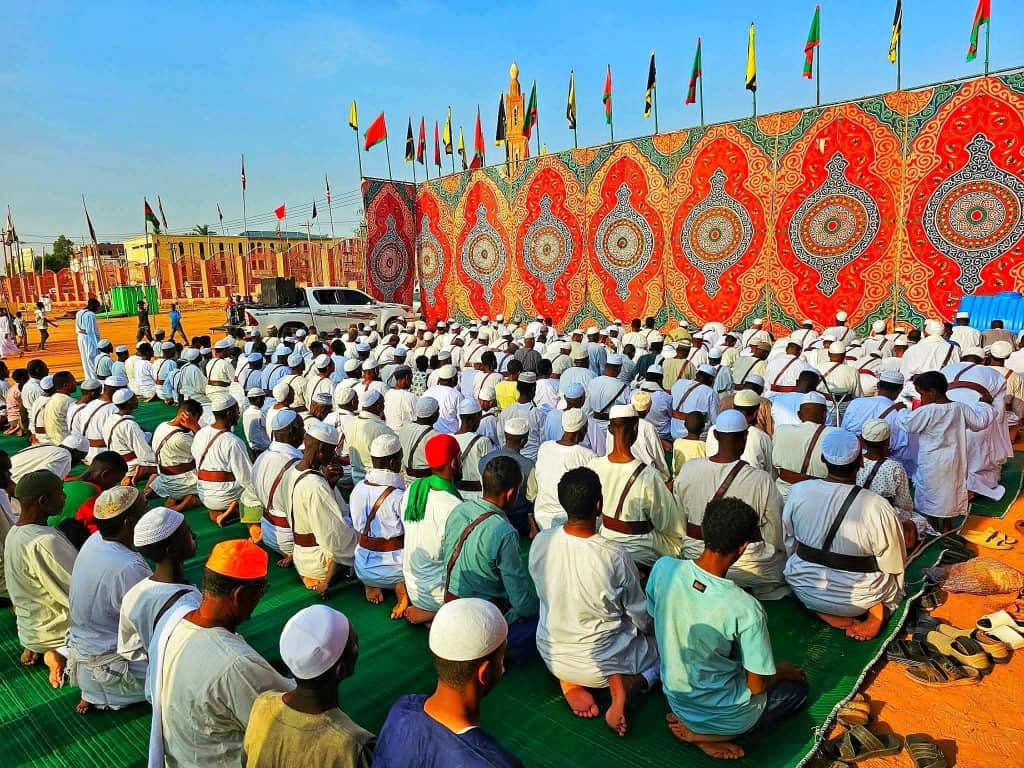
The month of the Prophet's birth is beloved by the people of Sudan, who consider it a sacred and blessed time. They favor family gatherings and holding engagement and marriage ceremonies during this time to seek blessings and good fortune from these days.
Post your comments
Photo of the Week

Cairo (Sudanow) The story began with a chance encounter on the afternoon of the 16th of this month. As I stepped out of my residence in Cairo, I noticed a young Sudanese woman, no older than twenty-four, hurrying through a narrow street crowded with pedestrians. I stepped aside to avoid colliding with her and jokingly remarked, "Take it easy; this is Cairo, not Khartoum." She ap...
More-

28 June, 2026
Stories from the Heart of the Battlefield On the Threshold of Waiting: Stories of Families Searching for Their Missing
Khartoum – Sudanow Wars are not measured solely by the numbers of the wounded and the dead; they are also measured by the silent voids they leave in the hearts of the living. These voids are created by forced absence, when a person becomes an unknown number or a name suspended between hope and despair. As Sudan’s war enters its fourth year, one of its most painful tragedies continues to unfold: the issue of missing persons,...

Contact Us

Address: Sudan News Agency (SUNA) Building, Jamhoria Street, Khartoum - Sudan
Mobile:+249 909220011 / +249 912307547