


Forests of Sudan in Wartime: From Collapse to Recovery Efforts
12 April, 2026
Khartoum (Sudanow) — As the war in Sudan enters its fourth year, the systematic destruction has affected every aspect of life. Humans, animals, and even birds have not been spared—many have abandoned their habitats, displaced just as people have been forced to flee.

To examine the scale of devastation in the forestry sector, Sudanow spoke with Dr. Abdelazim Mirghani, former Director General of the National Forestry Corporation, university professor, and former Secretary-General of the National Council for Combating Desertification at the Ministry of Environment.
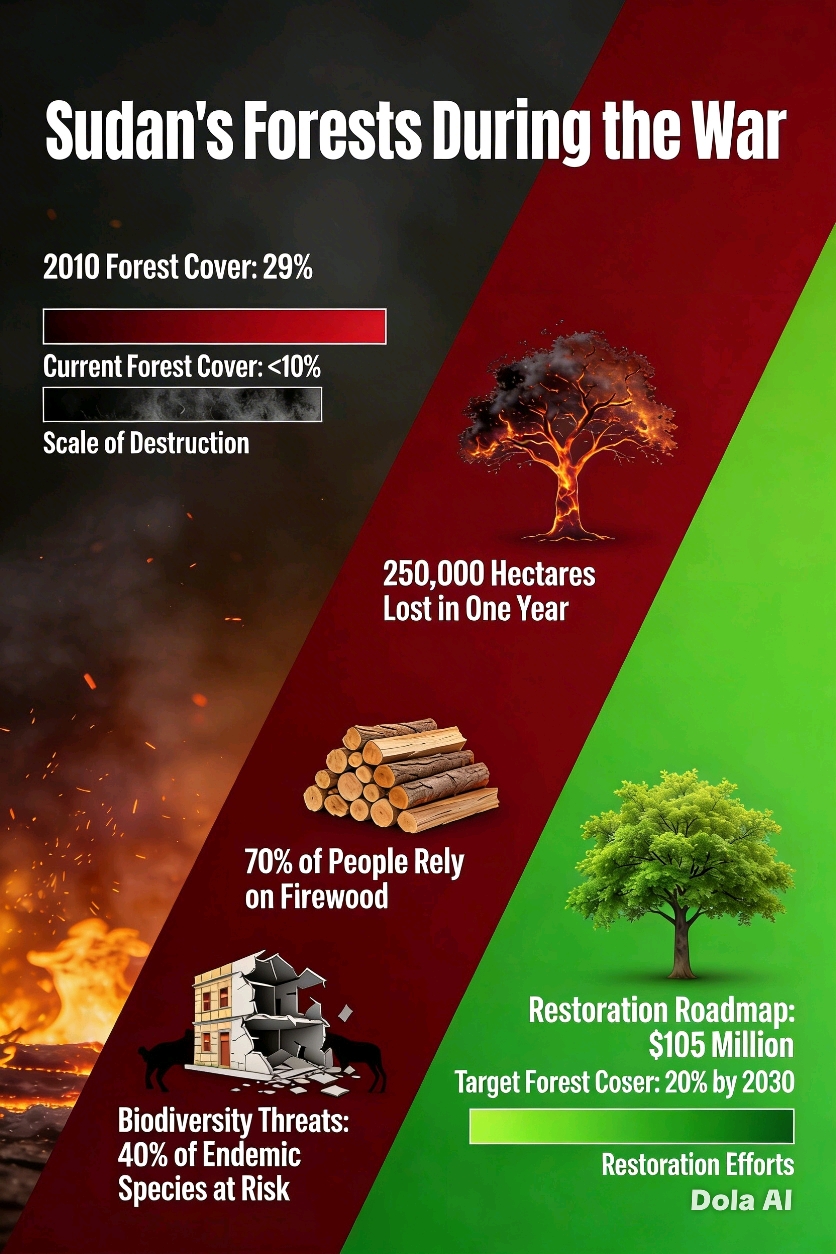
He explained that the war in Sudan is not merely a political conflict; it has evolved into comprehensive pressure on natural resources, particularly forests. In just one year, the country lost more than 250,000 hectares of forest cover, directly due to the collapse of the energy system. Amid the ongoing conflict, approximately 70% of the population has been forced to rely on firewood and charcoal following disruptions in electricity and gas supplies.
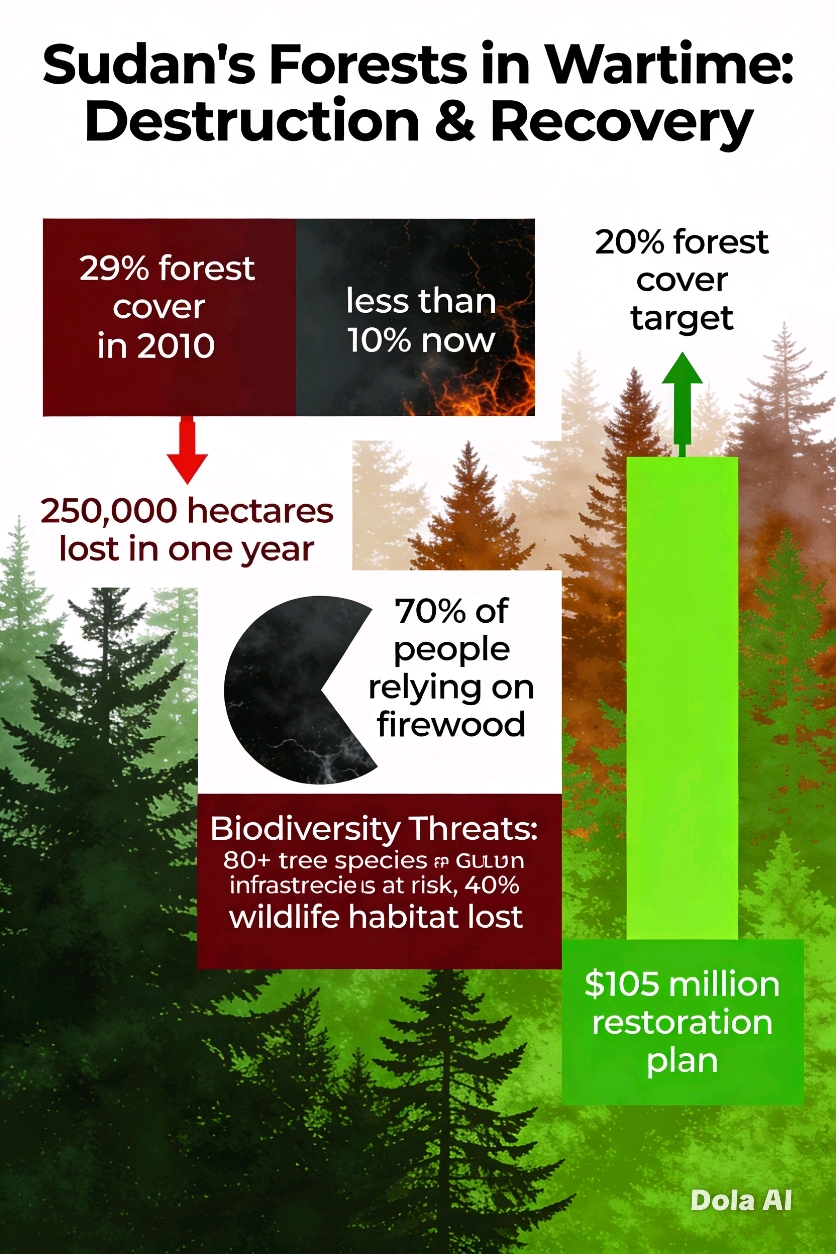
This loss cannot be separated from a longer-term downward trend. Forest cover had already declined to about 16% of the country’s total area before the war, compared to roughly 29% in 2010. Current estimates suggest that in some regions it has dropped to below 10%. In the absence of oversight, illegal logging rates have surged to three to four times their previous levels, particularly in Darfur, Kordofan, and Blue Nile regions.
Dr. Mirghani added that in displacement zones—especially in eastern and central Sudan—firewood consumption has become a major driver of environmental degradation. The average individual consumption is estimated at one cubic meter annually, leading to extensive deforestation around refugee camps and accelerating desertification.
At the heart of this crisis, the gum arabic sector has suffered a severe blow. Exports have declined by 50% to 60% due to insecurity, disrupted transport routes, destruction of storage facilities, and the displacement of producers. International estimates also indicate that the agricultural sector as a whole has contracted by more than 35–40%, with the most significant losses concentrated in cash crops.
Infrastructure has not been spared either. According to reports from the National Forestry Corporation, losses in the forestry sector have exceeded $100 million, including offices, nurseries, machinery, and transportation assets. This reflects the loss of more than 50% of operational capacity, resulting in near-total paralysis of forest protection and management activities.
Even protected areas and national parks have been affected. Regions such as Dinder and Radom have come under unprecedented pressure, with approximately 1.5 million displaced people moving into surrounding states. This has led to increased poaching, habitat degradation, and violations of protected zones that once served as critical reservoirs of biodiversity.
Despite this deterioration, forests have remained a vital lifeline during the war. Previous estimates suggest that forests contributed approximately $2 billion annually to national energy, in addition to providing construction materials valued at around $83 million per year—highlighting the significant gap left by their decline.
In this context, the war did not create the crisis from nothing; rather, it intensified existing environmental pressures. With mass displacement and the absence of effective governance, forests have become open-access resources. Tree density has declined sharply around urban areas and displacement camps, while in some regions forests have become part of military operations, used for camouflage and fortification, exposing them to direct destruction.

Despite the bleak picture, efforts to reverse the damage are underway. The government has developed a forest rehabilitation plan targeting approximately 300,000 hectares as an initial phase within a broader strategic vision. Before the war, this vision aimed to increase forest cover to 20% of the country’s area, equivalent to nearly 38 million hectares.
The total estimated cost of the project is $105 million, allocated as follows:
$35 million for forest restoration
$25 million to support the gum arabic sector and community engagement
$20 million to restore machinery and transportation assets
$25 million to rehabilitate infrastructure, including offices, nurseries, and equipment
The plan prioritizes high-vulnerability areas, particularly the gum arabic belt, Nile forests, the Nuba Mountains, and green belts around displacement camps. It goes beyond reforestation to rebuilding the relationship between people and forests by involving local communities and integrating youth and displaced populations into planting and management efforts.
It also includes a shift toward alternative energy sources—such as solar cookers and gas—to reduce dependence on firewood, alongside strengthening legal enforcement through a “community-based protection” model that positions local communities as the first line of defense.
However, the success of these efforts faces significant challenges, including limited funding and the need for international support through climate funds. There is also a pressing need to establish a national environmental monitoring system based on modern technologies such as satellite imagery.
In conclusion, Dr. Mirghani emphasized that the overall picture reveals widespread destruction of forests across 12 war-affected states that have been accessible for assessment. Yet it also highlights a parallel truth: despite their decline, forests still possess an inherent capacity for recovery.
The core message remains clear:
There is no food security without forests, and no environmental stability without their restoration.
But this recovery will not happen on its own—it requires willpower, partnership, funding, and informed management that recognizes forests not merely as resources, but as a complete life-support system.
Post your comments
Photo of the Week

Khartoum (Sudanow) — In just three days, the war in Sudan will complete its third year since it erupted on April 15, 2023. The conflict pits the Sudanese Armed Forces, supported by allied forces, against the rebel militia and its backers at both regional and international levels. Experts believe this war is no longer purely an internal affair; rather, it has evolved into...
More-

13 April, 2026
Stories from the Heart of the Battlefield War and the Growing Suffering of People with Disabilities
Khartoum (Sudanow) — As the war in Sudan enters its fourth year, and destruction has affected everyone, the suffering of people with disabilities has doubled. This vulnerable group faces severe risks due to war, displacement, and the difficulty of accessing medical and humanitarian aid, in addition to the near-total collapse of educational, medical, and rehabilitation services. To understand the scale of suffering and t...

Contact Us

Address: Sudan News Agency (SUNA) Building, Jamhoria Street, Khartoum - Sudan
Mobile:+249 909220011 / +249 912307547