


Minister of Health: More than 70% of Hospitals Back in Service… We Aim to Fully Restore the Health System
12 April, 2026
Khartoum (Sudanow)
Amid the severe challenges facing Sudan’s health sector as a result of the war that erupted three years ago, questions continue to arise about the Ministry’s ability to endure and provide essential services to citizens. In this interview conducted by Sudanow, Minister of Health Professor Haitham Mohamed Ibrahim outlines notable developments regarding the restoration of health services and improvements in medical supply chains, while acknowledging persistent challenges, particularly in Darfur and Kordofan. The discussion addresses key issues including the status of hospitals, disease outbreaks, medicine shortages, and the future of the health system.
With the war ongoing, what is the extent of the damage to health infrastructure, and what percentage of hospitals remain out of service?
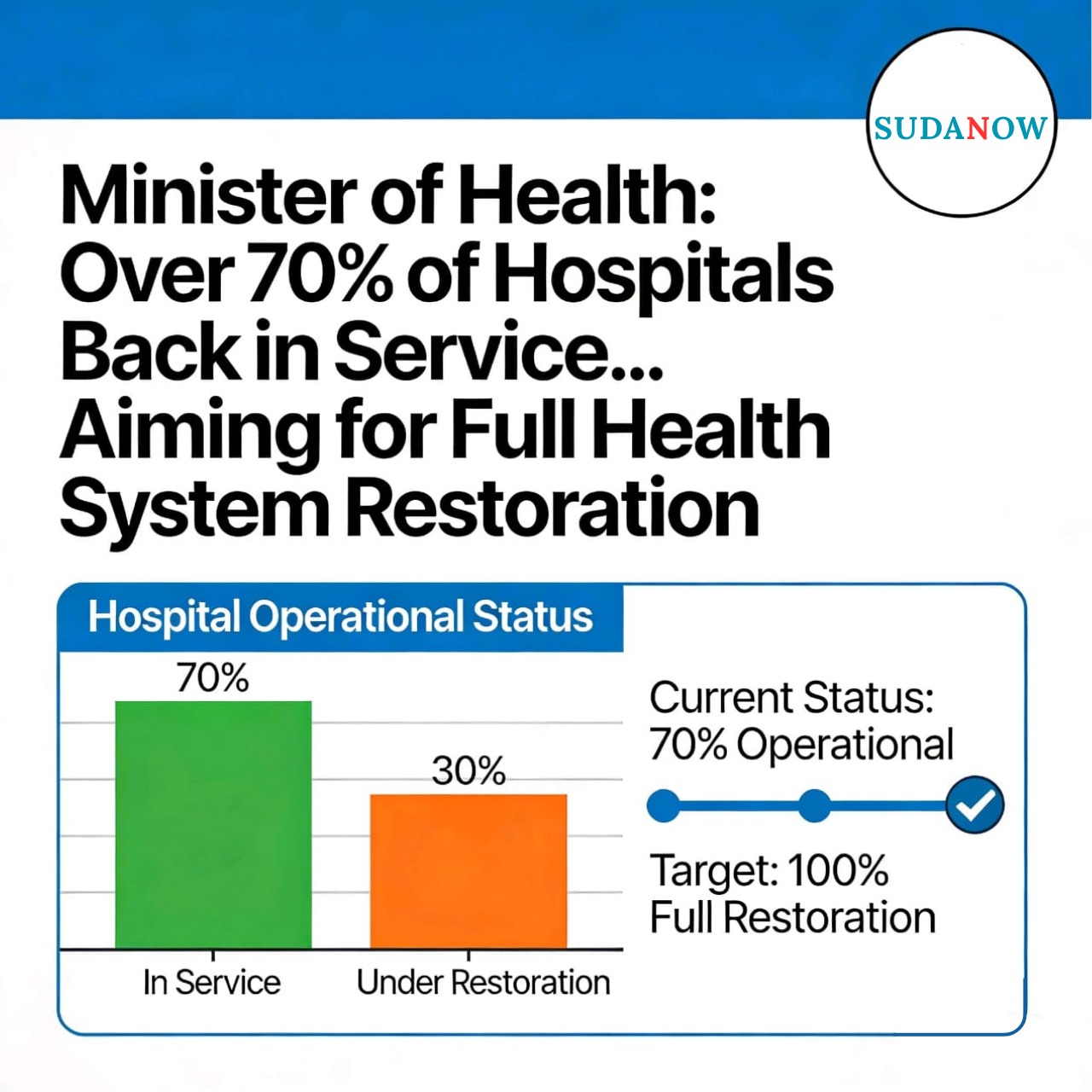
In reality, we have moved beyond the phase of discussing hospitals that were out of service, which characterized the first and second years of the war. Today, we can say that approximately 70% of hospitals have returned to operation. Even in Darfur, facilities that have not fully resumed services are now operating partially.

We are currently talking about health coverage exceeding 70% across Sudan’s states, with more than 4,000 health facilities providing a package of services. This is a significant achievement under the current circumstances, and we are working to ensure that the remaining hospitals in Darfur and Kordofan operate at full capacity.
Does the Ministry have accurate statistics on indirect deaths resulting from service disruptions, medicine shortages, or displacement?
Accurate statistics typically rely on annual health surveys that capture deaths reported within hospitals. However, during wartime and displacement, a large proportion of cases do not reach health facilities and therefore go unrecorded.

Overall, there has been a noticeable increase in mortality rates among patients with chronic illnesses, children, mothers, and individuals requiring dialysis. For example, there were approximately 7,000 registered kidney patients before the war; this number has now dropped to around 5,000, indicating the loss of about 2,000 patients due to death or displacement abroad. The final and precise figures will be determined through comprehensive annual data collection.
Medical supply chains were severely affected at the onset of the conflict. What is the current situation, and what is the extent of shortages in life-saving medicines?
At the beginning, the impact was devastating. Around 60% of the storage capacity was lost due to the destruction of central warehouses, and cold chain systems were almost entirely disrupted. Additionally, life-saving medicines worth over 500 million dollars were lost.
However, significant recovery has been achieved over the past year. The availability of essential medicines has increased from about 40% to approximately 75%, and more than 60% of the storage capacity in central warehouses in Khartoum has been restored following the return of electricity. This marks a major improvement in the stability of pharmaceutical supplies.
The migration of medical professionals has been one of the most serious challenges. What is your plan to address this issue?
This is a highly complex issue, particularly for those who have secured positions in universities or hospitals abroad. Our current strategy focuses on retaining existing staff by improving working conditions to ensure continuity of service.
As for those abroad who have not yet committed to permanent positions, we hope they will return once suitable conditions are in place. We are currently working on a comprehensive national plan for the health workforce, recognizing it as the cornerstone of the health system.
To what extent does Sudan currently rely on international support, and is there a risk of system collapse if this support ceases?
International support is a fundamental pillar at this stage, whether from United Nations agencies or partner countries. This support is crucial for programs related to epidemic control, maternal and child health, nutrition, and immunization.
Organizations such as the Global Fund and Gavi play a significant role, and regional partners have contributed to providing equipment and medical supplies. This cooperation has allowed the government to direct its limited resources toward urgent and essential needs. Continued support remains vital for maintaining system stability.
How is the Ministry responding to disease outbreaks under current conditions, and are surveillance systems effective?
There is a functioning epidemiological surveillance system operating regularly across all states, supported by a daily information network and weekly coordination meetings.
Response efforts are carried out in collaboration with international organizations and involve multiple strategies, including surveillance and investigation, rapid response, vaccination campaigns such as those targeting cholera, and vector control measures. These efforts depend heavily on rapid funding and close coordination with partners on the ground.

Is there a clear map of areas that can be considered medically underserved?
We do not describe any area as completely deprived of services, but rather as areas that are difficult to access. These are mainly located in parts of Darfur and Kordofan.
Basic services do reach these areas, often through United Nations agencies, but not at the required level due to fragile conditions. Improving the situation requires securing supply routes and ensuring the safety of health personnel.
What critical services has the Ministry not yet been able to restore despite urgent need?
The most pressing issue forcing patients to travel abroad is organ transplantation. This service has not yet been restored.
However, kidney transplant operations are expected to resume within the next three months, and liver transplant services are planned to return by the end of the year, which would significantly reduce the need for treatment abroad.
Another urgent issue is ensuring stable economic conditions for healthcare workers. Immediate solutions have not yet been achieved due to the country’s economic situation, although efforts are ongoing to improve conditions.
Finally, are we looking at a complete reconstruction of the health system, or is a return to pre-war conditions possible?
In my view, the health system will recover soon. It will not only return but also evolve to become stronger and more responsive than before the war.
The goal is not merely to restore what was lost, but to build a more resilient and effective health system capable of meeting future challenges.
Conclusion
This interview reveals a complex picture of Sudan’s health sector: noticeable improvements in some areas alongside deep structural challenges, including workforce shortages, access constraints, and heavy reliance on international support.
The central question remains: does this progress signal the beginning of genuine recovery, or is it a fragile stability within an ongoing crisis?
Post your comments
Photo of the Week

Khartoum (Sudanow) — In just three days, the war in Sudan will complete its third year since it erupted on April 15, 2023. The conflict pits the Sudanese Armed Forces, supported by allied forces, against the rebel militia and its backers at both regional and international levels. Experts believe this war is no longer purely an internal affair; rather, it has evolved into...
More-

13 April, 2026
Stories from the Heart of the Battlefield War and the Growing Suffering of People with Disabilities
Khartoum (Sudanow) — As the war in Sudan enters its fourth year, and destruction has affected everyone, the suffering of people with disabilities has doubled. This vulnerable group faces severe risks due to war, displacement, and the difficulty of accessing medical and humanitarian aid, in addition to the near-total collapse of educational, medical, and rehabilitation services. To understand the scale of suffering and t...

Contact Us

Address: Sudan News Agency (SUNA) Building, Jamhoria Street, Khartoum - Sudan
Mobile:+249 909220011 / +249 912307547