


Between Amnesty and Justice: The Sudanese State Equation in the Post-War Moment
03 May, 2026
Introduction
The war that has engulfed Sudan was not merely an isolated internal explosion; rather, it emerged within a broader context marked by the sharp intersection of a fragile national structure and extensive external interventions that sought to reshape the balance of power within the state. Within this environment, the impact of such projects did not remain confined to the sphere of conflict; it extended inward, where a complex pattern of alignments emerged. These alignments transcended ordinary political disagreement and evolved into positions, to varying degrees, linked to agendas and projects that undermined national unity and stability.
This alignment, chosen by some citizens, was not without cost. It left a profound imprint on the national conscience and reopened fundamental questions regarding the meaning and limits of patriotism, and the distinction between legitimate political opposition and engagement in trajectories that weakened the state and burdened its citizens. Thus, the war can no longer be read merely as a struggle over power, but rather as a severe test of the cohesion of national identity itself.
In light of this complex reality, any approach to peace settlement or general amnesty becomes subject to a dual challenge: how to ethically and nationally end the war without compromising justice, and how to restore national unity without disregarding the deep wounds left by the conflict. This necessitates the construction of a precise national formula that absorbs internal complexities and external pressures alike, balancing the requirements of political settlement, reconciliation, and equity.
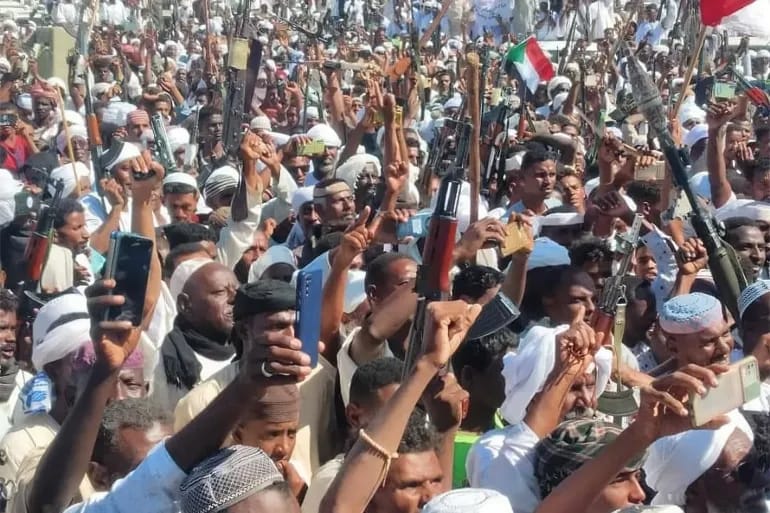
First: General Amnesty — From a Political Tool to a Disciplined Normative Framework
General amnesty, in post-conflict contexts, is not merely a political option aimed at easing tensions; it is a sovereign measure of high sensitivity, whose legitimacy depends on its consistency with justice and fairness. Historical experience demonstrates that an undisciplined amnesty does not end conflict; rather, it postpones it and reproduces its causes in subsequent cycles.
Accordingly, any move toward general amnesty in Sudan must be grounded in a strict normative framework based on:
* Non-absolute inclusion: exclusion of serious crimes that violate life and human dignity.
* Protection of victims’ private rights: as rights that cannot be extinguished by political arrangements.
* No waiver of serious crimes: such as rape, systematic violations, and extrajudicial killings.
Second: Justice — Within the Framework of Institutional Statehood and a Unified National Ceiling
Justice is not an isolated legal process; rather, it is an expression of the state’s capacity to manage conflict through independent institutions and within a unified national framework, away from political manipulation and retaliatory agendas.
This conception is based on:
* Independence of the judiciary, prosecution, and investigative bodies.
* Confining justice within a comprehensive constitutional framework.
* Neutralizing justice from political instrumentalization.
* Accountability according to uniform, non-selective standards.
* Truth-telling and preservation of national memory.
* Reparations as a right, not a concession.
* Institutional reform to prevent recurrence of violations.
* A gradual transitional justice process that is neither excessive nor hasty.
Third: Between National Opposition and Treason — A Line That Cannot Be Blurred
In the complex post-war environment and its repercussions, the risk of conflating legitimate political opposition with acts that undermine state sovereignty becomes pronounced. This requires precise conceptual demarcation, free from political exploitation and campaigns of exclusion or historical erasure.
This distinction rests on:
* Affirmation of the legitimacy of political pluralism.
* Restricting treason and espionage to precise legal definitions.
* Non-use of accusations for political or media purposes.
* Ensuring independent judiciary processes to adjudicate facts.
* Differentiating political error from criminal conduct.
* Protecting public space from generalization and stigmatization.
Fourth: Political Opening and the Unified National Ceiling — With Constraints of Realistic Assessment
Political openness is essential for rebuilding the public sphere; however, it must be managed under conditions where varying degrees of conflict persist and external influences remain active.
This trajectory is based on:
* Linking political openness to a minimum threshold of security stability.
* Avoiding premature assumptions about the end of war.
* Recognizing the continuation of external interventions.
* Adopting a unified national ceiling as a reference framework.
* Preventing the reproduction of conflict tools through politics.
* Constraining political assessments and avoiding premature declarations of stability while conditions remain fluid.
Fifth: Lessons from Sudanese History — When Incomplete Settlements Produce Cycles of Conflict
The Sudanese experience demonstrates that partial settlements which ignored the root causes of crises led to the reproduction of conflict in more complex forms.
Among the key lessons:
* Partial settlements postpone conflict rather than end it.
* Absence of justice reproduces violence.
* Weak institutions render agreements fragile.
* Neglect of social dimensions deepens the crisis.
* External interventions undermine the sustainability of agreements.
Conclusion: Toward an Equation that Preserves the State and Safeguards Collective Consciousness
At the end of this complex trajectory, a central truth emerges that cannot be overlooked: Sudan’s future cannot be built upon denial, superficial settlements, or disregard for the deep wounds left by war in the social fabric and national conscience.
What is required is not merely a cessation of war or political rearrangement devoid of a consensual national vision that elevates internal agency and ownership, but rather a reconstitution of the very meaning of nationhood—one that preserves the state from fragmentation, safeguards the collective consciousness of the Sudanese people, and restores the dignity and pride of a nation deeply wounded.
In this context, grave violations committed against the nation—killing, abuse, looting, and terrorization—cannot be reduced to mere political incidents without accountability. These acts are not simple political disagreements; they are crimes that strike at the core of the state and society, and they carry an inevitable and just cost—not as vengeance, but as a safeguard for the future and a deterrent against the recurrence of collapse.
Any pathway toward settlement, amnesty, or political opening will only gain legitimacy if it rests on a fundamental principle: that true peace cannot be built on impunity, but rather on justice that restores victims’ rights, establishes a clear boundary for accountability, and reinstates the authority and dignity of the state and its institutions.
Accordingly, the future equation is urgent, yet it is not a binary choice between amnesty and justice; rather, it is a balance between justice that preserves the state without destroying it, and amnesty that does not forfeit rights or entrench impunity—within a unified national framework that restores Sudan’s equilibrium, preserves its unity, and reclaims its standing on the foundations of law, equity, and collective dignity, not the pursuit of power before fulfilling the requirements of a comprehensive and binding national equation—guided by historical lessons and the accumulated experiences of nations.
Post your comments
Photo of the Week

Khartoum (Sudanow) — In just three days, the war in Sudan will complete its third year since it erupted on April 15, 2023. The conflict pits the Sudanese Armed Forces, supported by allied forces, against the rebel militia and its backers at both regional and international levels. Experts believe this war is no longer purely an internal affair; rather, it has evolved into...
More-

20 April, 2026
Stories from Inside the Battlefield At the Threshold of Waiting: Stories of Families Searching for Their Sons
Khartoum (Sudanow) — Wars are not measured by the number of wounded and dead, but by the silent voids they leave in the hearts of the living—voids created by enforced disappearance, when a person turns into an unknown number or a suspended name between hope and despair. As the war in Sudan enters its fourth year, one of its most painful tragedies is becoming increasingly evident: the issue of missing persons, which ...

Contact Us

Address: Sudan News Agency (SUNA) Building, Jamhoria Street, Khartoum - Sudan
Mobile:+249 909220011 / +249 912307547