


How a Different AI War is waged against the Sudan
31 May, 2026
Khartoum (Sudanow) - An academic study on how, atrocities are being encouraged in the Middle East and North Africa (MENA) in General and the Sudan in particular through the use of “Sock puppets, Bots and Digital Information” and the end result is “Harm in Wartime”.
To put it simply and away from the academic jargon, this is a study that says another form of support to the foes of the government and people of Sudan, has been going on for years, using fake accounts and disinformation tools.
This time it is not in the form of military assistance or logistical or mercenary support. This support takes the form of trying to undo whatever positive elements coming out of the Sudan, and backing and justifying whatever form of atrocities committed by the Rapid Support Forces (RSF) militias.
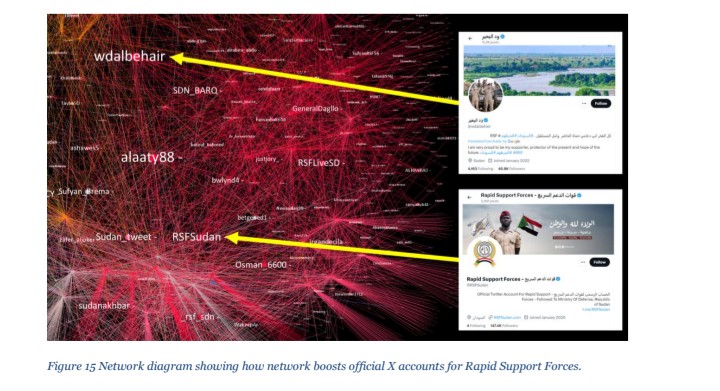
It is an electronic warfare that goes after all accounts operating in X platform, heaping AI produced tweets and commentary in a way that any positive or favorable tweets or comments in favor of the Sudanese army and government in place would be eclipsed.
And it is a serious study> It is produced under the auspices of the UNESCO Chair on Data, Media and Society at the University of South Carolina. It forms part of a research agenda into the role of data-driven media systems in shaping political perception, public knowledge, and information integrity in conflict affected and ‘atrocity risk’ affected contexts.
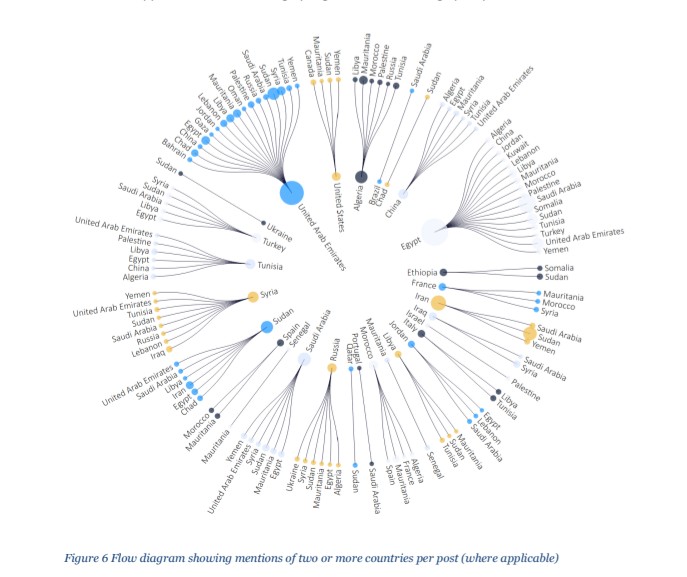
The report summarizing the study, released end of May 2026, said the subject matter has focused on large-scale coordinated influence operations across the Middle East and North Africa (MENA).
“Specifically, this report documents and analyses three large-scale, coordinated sock puppet and bot networks operating across the Middle East and North Africa (MENA), with particular emphasis on activity surrounding Sudan’s civil war. “ it stressed.
The study under the name: Enabling Atrocity in the MENA and Sudan: Sock puppets, Bots and Digital Information, Harm in Wartime” was spearheaded by professor Marc Owen Jones, an Associate Professor of Media Analytics at Northwestern University in Qatar.
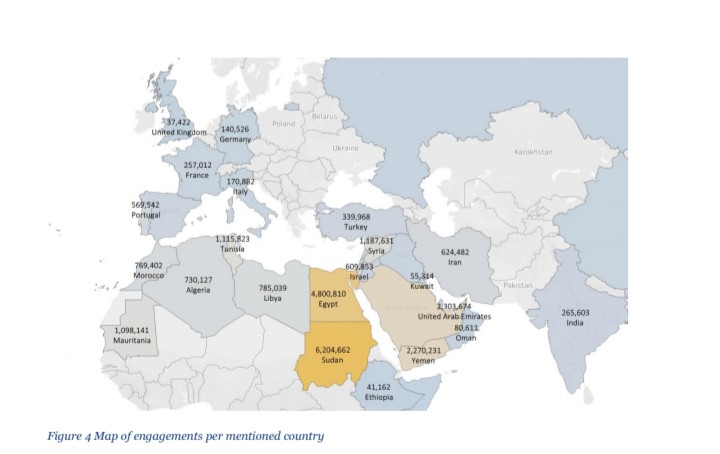
The summary said this report documents and analyses three large-scale, coordinated sock puppet and bot networks on the X platform (formerly twitter) operating across the Middle East and North Africa (MENA), with particular emphasis on Sudan’s civil war, which pits the paramilitary Rapid Support Forces (RSF) against the government-backed Sudanese Armed Forces (SAF).
“Drawing on the analysis across three distinct networks of more than 250,000 social media posts produced in Arabic, English, Persian, Turkish and French, and covering a period of over two years, the report identifies sustained influence operations involving over 27,000 inauthentic accounts used to promote state-aligned geopolitical narratives to reshape public understanding of the civil war in Sudan.” it argued.
According to the published report this study while surveying MENA-wide activity, including campaigns targeting Iran, Mauritania, Morocco, Algeria, Libya, Yemen, Syria, Tunisia, Saudi Arabia, and the United Arab Emirates, the core empirical focus concerns networks promoting the Rapid Support Forces during the Sudan conflict.

These networks operated over different periods and across multiple languages, indicating persistence, adaptation, and strategic reuse rather than episodic activity.
The report said the study has examined the “Tactics, Techniques, and Procedures (TTPs)” of three different bot and sock puppet networks. TTPs are the specific behaviors, processes, and patterns of activity that threat actors use to design, scale, and execute disinformation campaigns.
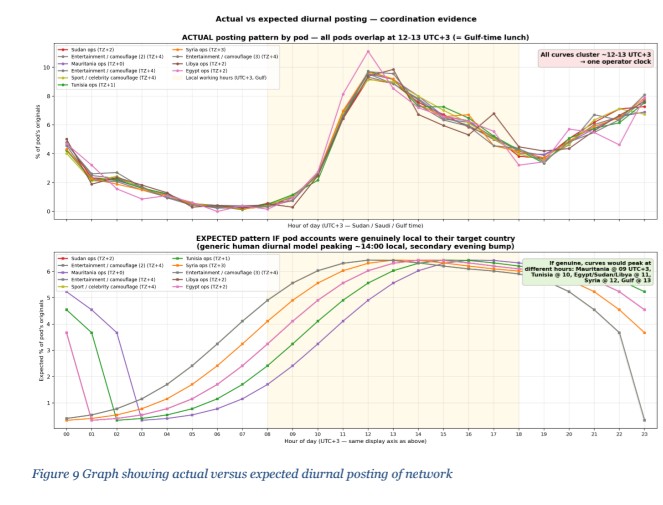
Adapted from cyber security threat-mapping frameworks, tracking disinformation TTPs allows security analysts, civil society organizations, and governments to identify coordinated influence operations, predict adversary behavior, and build systemic resilience
And it has identified three MENA-wide sock puppets and bot networks comprising over 27,000 fake accounts that have produced hundreds of thousands of posts, operating across Arabic, English, Persian, Turkish and French. They have largely been promoting an anti-Islamist, pro-RSF, and UAE-aligned political narrative.
It also came to the conclusion that there is a “systematic promotion of RSF-aligned narratives in Sudan: across multiple datasets, the networks overwhelmingly promoted pro-RSF and anti-SAF Burhan narratives, portraying the RSF as humanitarian, peace-seeking, and legitimate, while attributing civilian harm, famine, and obstruction of aid almost exclusively to the SAF and Islamist actors.
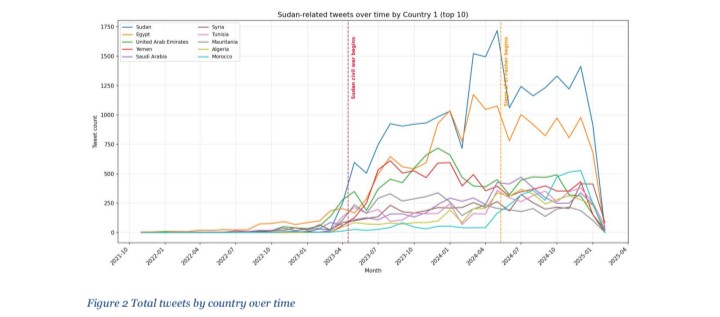
The study also showed the networks and the accounts are being used to “whitewash genocide and violence”, citing as example that in the aftermath of El Fasher, coordinated hashtag campaigns reframed violence as recovery and normalization, illustrating a pattern consistent with image repair theory.
The study pinpointed that the Sudan-related corpus centers on two principal antagonists: Abdel Fattah al-Burhan, head of Sudan’s Sovereignty Council and commander of the Sudanese Armed Forces (SAF), and Mohamed Hamdan Dagalo (“Hemeti”), leader of the Rapid Support Forces (RSF), alongside civilian political actors such as former Prime Minister Abdullah Hamdok.
“Across the tweets, Sudan is framed through a highly polarized and internally consistent narrative architecture that divides political actors into moral absolutes rather than contested positions. Abdel Fattah al-Burhan and the SAF are constructed as the primary agents of violence, obstruction, and moral failure.”
It reached one major conclusion that in keeping with other analysis on Sudan’s disinformation, those aligned with the SAF are often portrayed as elites. The term ‘remnants’ (fulul) is often used to describe and delegitimize those seen as still being part of Omar al-Bashir’s era.
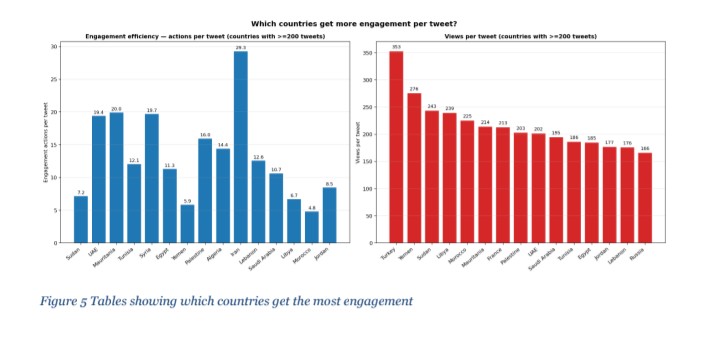
In stark contrast, Mohamed Hamdan Dagalo (Hemedti) and the RSF are depicted as legitimate, humanitarian, and peace-seeking actors. Hemedti is framed as a statesman engaged in diplomacy and committed to civilian protection, frequently described as a “leader of peace” and a “symbol of courage and humanity.
Civilian political actors aligned with democratic transition, particularly Abdullah Hamdok and the Coordination of Civil Democratic Forces, are positioned as complementary to RSF legitimacy. Hamdok is repeatedly framed as “the voice of reason” and “the hope of civilians,” working in tandem with RSF efforts to end the war through dialogue. International organizations, by contrast, appear largely as ineffective or obstructed, with humanitarian failure attributed overwhelmingly to the SAF, which is accused of “blocking aid,” “weapon zing hunger,” and “bombing hospitals.” This attribution further consolidates the moral asymmetry at the heart of the narrative.
Equally significant is what is absent. Across the corpus there is no sustained internal critique of RSF conduct, leadership, or historical lineage. Reports of RSF abuses are either omitted or dismissed as fabrications carried out by “Burgan’s militias in RSF uniforms.” This systematic silence, alongside the uniformity of praise, indicates a disciplined narrative environment shaped as much by omission as by repetition.
One conclusion reached it that “taken together, this narrative structure promotes one side of the conflict through repetition, omission, emotive language, and selective quotation. The corpus advances a rehabilitative framing of the RSF while externalizing blame for mass violence. The result is a form of narrative saturation in which scale and effect displace contestation, accountability, and complexity.”
It explained that the overwhelming majority of tweets and statements in this collection present the Rapid Support Forces (RSF) in a distinctly positive light. This dominant narrative portrays the RSF as heroic defenders of the Sudanese people, committed humanitarian actors, and champions of democratic reform fighting against what they repeatedly call "remnants" of the former regime.
Throughout the document, the study continues, the RSF are predominantly characterized as protectors who secure neighborhoods, distribute aid, restore essential services, and safeguard civilians from harm. They are frequently depicted as peace-seeking, with numerous messages highlighting their willingness to participate in ceasefires and negotiations while claiming their opponents escalate conflicts. A significant number of tweets celebrate supposed RSF military victories, describing them "liberating" various regions across Sudan.
Other common descriptors include "forces of truth," "heroes of the homeland," "guardians of peace and security," and "liberators" of various regions across Sudan. The RSF are consistently portrayed as "humanitarian forces" providing essential services and aid, a "fortress of security," and a "strong shield for civilians." Many messages characterize them as a "symbol of unity and loyalty" and the "backbone of security and stability" in Sudan.
This language creates a heroic narrative around the RSF, presenting them as an "unbeatable force" of "faithful guardians" and "sons of the nation" dedicated to protecting democracy and civilian welfare.
This remarkably consistent and glowing portrayal appears in tweet after tweet, suggesting a coordinated messaging campaign designed to shape public perception of the paramilitary group in the most favorable light possible.
But it remarked that noticeably absent from this collection are elements of any substantive criticisms of the RSF. When negative actions are mentioned, they are almost invariably attributed to opponents disguised as RSF members or dismissed as fabrications. The one-sided nature of these descriptions stands in stark contrast to reports from international human rights organizations about the group's activities.
This network also actively amplified and boosted official RSF accounts, before they were suspended by X. This included RSF’s official account, and its spokesperson, Wad Elbe hair, both of which functioned as central amplification hubs. Within the Sudan-focused subset, pro-RSF accounts were the most heavily promoted, underscoring the network’s role in systematically boosting RSF-aligned narratives prior to the removal of assets.
It further raised questions for discussion pinpointing that the report has examined three distinct but interlocking influence networks involving thousands of fake social media accounts operating across Sudan and the wider MENA region.
“Taken together, they demonstrate that contemporary disinformation in conflict settings consists of different layers of deception that exploit platform affordances in different ways, from long-lasting networks that sustain influence over time, to almost disposable, rapidly deployed shock troops designed to manipulate trends and engage in crisis communication. Regardless, they all work to reshape the visibility of propaganda at precisely the moments when prevention, accountability, and civilian protection are most fragile.
“The findings across the three networks reinforce the argument that atrocity-risk propaganda operates through the manipulation of information environments during periods of mass violence. In Sudan, these campaigns occurred during one of the gravest humanitarian crises in the world, including periods in which international investigators warned of genocide risk and famine conditions in Darfur. “The study underlined.
Under such conditions, the manipulation of information ecosystems carries implications for atrocity prevention, humanitarian response, and accountability itself.
It argued that the three networks degraded each of the atrocity-prevention pathways identified earlier in this report. At the level of structural prevention, they contributed to the erosion of pluralistic and trustworthy information environments through the sustained simulation of civic participation.
The report also demonstrates how contemporary atrocity propaganda increasingly operates through platform affordances. Visibility systems on X, including trending algorithms, engagement metrics, verification systems, and recommendation infrastructures, were repeatedly exploited to manufacture credibility through scale and repetition.
The emergence of AI-assisted “reply guy” networks deepen these concerns further. Network Three simulated interpersonal participation by entering conversations with journalists, influencers, and ordinary users through synthetic but conversational personas, highlighting the dangers of GenAI in propaganda systems. This marks an AI-assisted evolution toward propaganda embedded directly within social interaction. Future influence operations are therefore likely to further blur distinctions between authentic civic participation and synthetic engagement even further, complicating detection while increasing persuasive and agenda-setting capacity.
Taken together, the networks documented in this report demonstrate how coordinated inauthentic behavior can function as a form of atrocity-enabling infrastructure. This was clearly seen in El Fasher massacres, October 2025, and as recently as in Bara locality in May 2026. Thus, the study has shown why the world was being kept in the dark by such ploys and disinformation campaigns.
Post your comments
Photo of the Week

Cairo (Sudanow) The story began with a chance encounter on the afternoon of the 16th of this month. As I stepped out of my residence in Cairo, I noticed a young Sudanese woman, no older than twenty-four, hurrying through a narrow street crowded with pedestrians. I stepped aside to avoid colliding with her and jokingly remarked, "Take it easy; this is Cairo, not Khartoum." She ap...
More-

28 June, 2026
Stories from the Heart of the Battlefield On the Threshold of Waiting: Stories of Families Searching for Their Missing
Khartoum – Sudanow Wars are not measured solely by the numbers of the wounded and the dead; they are also measured by the silent voids they leave in the hearts of the living. These voids are created by forced absence, when a person becomes an unknown number or a name suspended between hope and despair. As Sudan’s war enters its fourth year, one of its most painful tragedies continues to unfold: the issue of missing persons,...

Contact Us

Address: Sudan News Agency (SUNA) Building, Jamhoria Street, Khartoum - Sudan
Mobile:+249 909220011 / +249 912307547