


The Mecca Tripartite Agreement: Has the Reshaping of Regional Security Begun?
15 August, 2026
For years, the Middle East has been undergoing a transition from a traditional security system largely based on the American security umbrella toward a more complex environment characterized by multiple sources of power, threats, and deterrence.
The latest regional three-way war, accompanied by missile and drone attacks, disruptions to energy flows and maritime navigation, and repercussions for the Gulf states and the wider region, has demonstrated that the security of the Gulf and the Red Sea can no longer be treated separately from the security of the Eastern Mediterranean, the Horn of Africa, and the Indian Ocean.
Against this backdrop, the Mecca Agreement represents more than a defense treaty.

In my view, it signals an attempt to build a new layer of regional security based on collective deterrence and diversified partnerships rather than dependence on a single external guarantor.
The agreement establishes a highly significant principle: an armed attack against any one of the three countries will be treated as an attack against all three, while emphasizing that the agreement is defensive in nature and is not directed against any particular state.
Why Now?
The most important question is not: Why did the three countries sign the agreement? Rather, it is: Why now?
The timing comes amid a security environment radically different from that of previous years. Regional conflict is no longer confined to conventional land fronts; it has expanded to include missiles, drones, critical infrastructure, ports, maritime routes, and energy and food supply chains.
Disruptions to navigation in the Red Sea and the Gulf of Aden, along with continuing risks to commercial shipping, have also prompted the European Union to extend Operation Aspides until February 2027 to safeguard freedom of navigation.
Consequently, regional states are no longer facing the traditional question of how to defend their borders. They are confronting a far more complex question:
How can a state protect its economy, energy resources, ports, maritime routes, and strategic projects in a world where threats may emerge hundreds of kilometers beyond its borders?
This is where collective deterrence becomes increasingly attractive.
Saudi Arabia: From Seeking Protection to Diversifying Sources of Deterrence
Saudi Arabia appears to be at the heart of this transformation.
Riyadh does not appear to be moving toward abandoning its strategic partnership with the United States. At the same time, however, it is working to reduce the risks associated with relying on a single power.
This is not a rupture with Washington. Rather, it represents a redistribution of Saudi national-security risks.
The new equation can be summarized as a shift:
From: Saudi security under the umbrella of an external power
To: Saudi security within a network of multiple sources of power.
Türkiye and Pakistan enter this network for different reasons.
Türkiye provides the triangle with conventional military strength, defense industries, technological capabilities, and operational experience, while Pakistan contributes exceptional military and strategic weight, in addition to being a nuclear-armed state.
Saudi Arabia, meanwhile, contributes geographic positioning, economic weight, energy resources, and political and religious significance.
This is therefore not a system based on similar capabilities, but on the complementarity of different forms of power.
Pakistan and Nuclear Ambiguity
Pakistan's presence in the agreement is one of its most sensitive elements.
It would be inaccurate to claim that the agreement has created a “Pakistani nuclear umbrella” for Saudi Arabia, as the publicly available text contains no provision establishing such an arrangement.
Nevertheless, the presence of a nuclear-armed state within a collective defense framework naturally changes deterrence calculations.
This is where the importance of strategic ambiguity emerges.
Deterrence does not always require an explicit declaration of the nature of a potential response. It may be sufficient for an adversary to understand that attacking one member of the arrangement could trigger a chain of consequences that would be difficult to control.
Thus, Pakistan's value within the agreement is not merely military. It is also strategic, psychological, and deterrent.
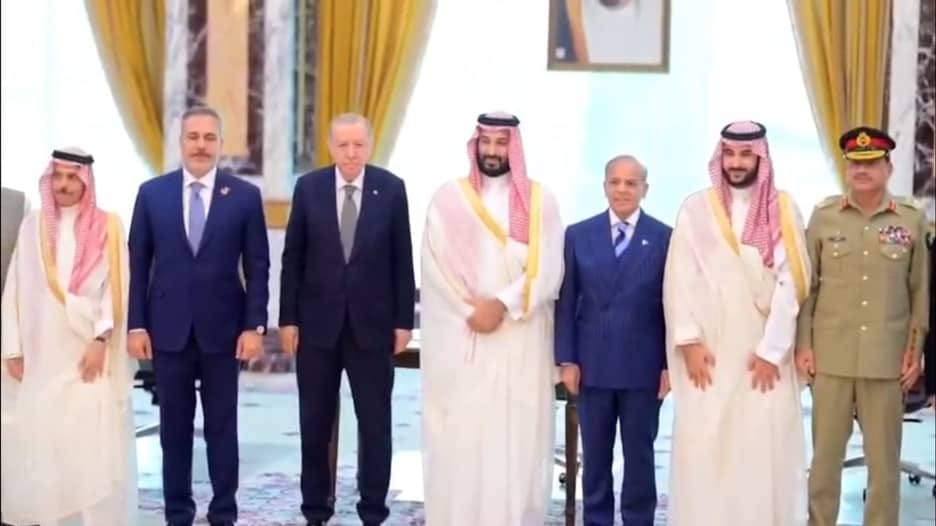
Türkiye: The Operational Link
Türkiye, for its part, adds advanced military, industrial, and technological capabilities, as well as its geographic position and extensive operational experience in diverse regional environments.
The convergence of Saudi Arabia, Türkiye, and Pakistan therefore produces, theoretically, a triangle possessing three distinct forms of power:
- Saudi economic and geographic weight;
- Turkish military and technological capabilities;
- Pakistani military and strategic weight.
This is the agreement's real strength.
Is It Directed Against Iran?
Officially, no.
Strategically, however, Iran will certainly be among the actors compelled to reassess its calculations.
Alliances are not measured solely by what their signatories publicly declare. They are also measured by the new calculations they impose on potential adversaries.
If pressure on Saudi Arabia previously meant entering into a confrontation with Saudi Arabia and its immediate partners, the new equation means that any potential attack could also involve Türkiye and Pakistan.
That raises the cost of military adventurism.
The agreement may therefore convey another message to Iran:
The era of unilateral deterrence is receding, while the era of networked deterrence is advancing.
Israel and the United States in the Equation
Israel, too, will not be able to ignore this development, even if the agreement is not officially directed against it.
The region is witnessing a transition from a security system in which regional powers relied to varying degrees on major external powers toward an environment in which states are seeking to develop their own deterrence capabilities.
As for Washington, the most important message may actually be directed toward the United States.
Saudi Arabia is not telling America:
“We do not need you.”
Rather, it is saying:
“We need you, but we do not want our security to depend on you alone.”
That is a strategically significant distinction.
The Red Sea: The Dimension That Makes the Agreement More Significant
This is precisely where the analysis needs to be broadened.
Viewing the Mecca Agreement solely as a Gulf security arrangement would underestimate its significance.
Saudi Arabia has a coastline on the Red Sea. Türkiye has an increasingly significant presence in the strategic environment of the Horn of Africa, while Pakistan is directly connected to the Indian Ocean and the Arabian Sea.
The geographic space of the triangle therefore extends across:
The Arabian Gulf → the Red Sea → Bab el-Mandeb → the Gulf of Aden → the Arabian Sea → the Indian Ocean.
This means that Gulf security can no longer be separated from Red Sea security.
The Red Sea itself is no longer merely a maritime corridor. It has become an arena where the interests of multiple regional and international powers intersect.
In addition to the coastal states, several international maritime security arrangements operate in the area. The Combined Maritime Forces, comprising 47 countries, includes Combined Task Force 153, whose mission focuses on maritime security in the Red Sea and Gulf of Aden. The European Union also continues its Operation Aspides to safeguard freedom of navigation.
We are therefore dealing with a maritime space where multiple regional and international powers intersect, rather than an isolated or closed security zone.
The “Red Sea Force” Is Not Far Removed From the Picture
From this perspective, the countries bordering the Red Sea and directly connected to its security can be viewed as constituting a regional security layer of their own.
The regional system concerned with the protection of the Red Sea and Gulf of Aden includes Saudi Arabia, Egypt, Sudan, Eritrea, Yemen, Djibouti, Somalia, and Jordan, while overlapping with broader international and maritime arrangements.
In addition, the Red Wave naval exercises have brought together, in one of their iterations, Egypt, Saudi Arabia, Jordan, Sudan, Yemen, and Djibouti in maritime exercises involving countering fast boats, anti-submarine warfare, and coastal security.
This brings us to a strategically important point:
The Red Sea already possesses the seeds of a regional security architecture, but they remain distributed among bilateral, multilateral, regional, and international arrangements.
Could these different tracks eventually converge?
That is the question that deserves close attention.
Sudan at the Heart of the Equation
If the Gulf represents one component of the emerging security architecture, Sudan represents a link that cannot be bypassed in the Red Sea equation.
Sudan possesses not only a long Red Sea coastline, but also a strategic position connecting the Arabian Peninsula with the Horn of Africa and East Africa.
Consequently, any reshaping of Saudi-Turkish-Pakistani security arrangements, as well as any development in Red Sea security, will have a direct or indirect impact on Sudan.
Indeed, Sudanese security itself needs to be redefined in light of this transformation.
Sudan should not view the Red Sea merely as a commercial outlet or geographic coastline. It should regard it as a core component of national security and one of the keys to its position within the regional system.
The security of ports, maritime navigation, energy infrastructure, protection of trade routes, and countering maritime threats are all areas that could enable Sudan to become a partner in the maritime security equation rather than merely a recipient of its repercussions.
Here lies an opportunity for Sudan to benefit from its geographic position—provided it succeeds in transforming geography into policy, and policy into shared interests.
From the Mecca Agreement to a Red Sea Security Architecture?
Perhaps this is the most intriguing question.
Could the Mecca Agreement eventually evolve into broader arrangements connected to Red Sea security?
Not necessarily through the accession of additional countries to the agreement itself, but through functional areas of cooperation such as:
- Maritime intelligence sharing;
- Port security;
- Navigation monitoring;
- Cybersecurity coordination;
- Countering missile and drone threats;
- Protection of energy infrastructure;
- Combating piracy and smuggling;
- Securing Bab el-Mandeb;
- Coordinating responses to maritime crises.
If such developments occur, the Mecca Agreement could evolve from a trilateral defense arrangement into an anchor point within a broader security network extending from the Gulf to the Red Sea and the Indian Ocean.
Are We Witnessing the Emergence of an “Islamic NATO”?
Not yet.
But it would also be a mistake to ignore the direction in which the agreement could potentially lead.
An alliance does not become influential merely because a treaty has been signed. It becomes influential when the treaty develops into:
Institutions + command structures + intelligence cooperation + joint exercises + air defense + maritime security + defense manufacturing + joint response capabilities.
If these elements materialize, the emergence of a new regional defense architecture will become a far more realistic proposition.
For now, however, the Mecca Agreement represents a political and deterrent framework with the potential to evolve.
Conclusion: The Middle East Enters the Age of “Networked Deterrence”
The emerging picture goes beyond the idea of a trilateral alliance.
It represents a shift:
From bilateral alliances
to multilateral deterrence networks.
From security produced by a great power
to security jointly produced by regional powers for the benefit of the region and the wider world.
From the Gulf as a separate security zone
to an interconnected security space extending from the Gulf to the Red Sea, Bab el-Mandeb, the Arabian Sea, and the Indian Ocean.
At the center of these transformations stands the Mecca Agreement.
It may not be an “Islamic NATO.” It may not be directed against Iran, Israel, or the United States, according to the official narrative.
But international politics is not measured solely by declared intentions. It is also measured by the changes in power and deterrence calculations produced by agreements.
Therefore, the real question is not:
Who is the Mecca Agreement directed against?
The real question is:
What security system does this agreement seek to become the nucleus and foundation of?
If it remains confined to a political commitment, it will serve primarily as a deterrent message.
But if it evolves into a shared military, intelligence, and maritime structure, it could become one of the keys to reshaping the regional security order.
In that case, the Red Sea will not be a peripheral element of the story.
It may instead become the arena where the consequences of the Mecca Agreement intersect with the interests of the Gulf, the Horn of Africa, and the Indian Ocean.
Sudan, by virtue of its geographic position, would then face both a historic opportunity and a strategic challenge:
Either it remains an object within Red Sea security arrangements designed by others, or it rediscovers its position as a pivotal state capable of contributing to the production of Red Sea security itself.
And perhaps this is the deepest message of the Mecca Agreement:
The era of unilateral security is receding, while the age of networked deterrence and the redistribution of regional power may already have begun.
“When interests converge around security, geography ceases to be merely a space of influence and becomes a space for the redistribution of power. The Mecca Tripartite Agreement may therefore be not the end of an equation, but the beginning of a new security architecture—one whose depth and direction will be revealed by the Red Sea and Sudan".
Post your comments
Photo of the Week

Khartoum – Sudanow The Sudanese nation celebrates, on August 14, the 72nd anniversary of the Sudanese Armed Forces, a national occasion that recalls the bright chapters of an army that, for decades, has remained one of the foremost pillars of the state and a guardian of its sovereignty and security. The editorial team of Sudanow Magazine extends its highest congratulation...
More-
15 August, 2026
The Abdulla Tayeb Hall Rises Out of the Ashes Anew
Like the ancient phoenix myth, taught to hundreds of its graduates within this Hall 102, the graduates are enacting it once again, in real life, in action, and contribution.The Sudanow magazine (https://sudanow-magazine.net/page.php?subId=31&Id=1686) has earlier written about the devastation that hit the famous 102 (one-o-two) Hall, the beating heart of the faculty of arts, at the hand of barbaric militias, an orchestrated a...


Contact Us

Address: Sudan News Agency (SUNA) Building, Jamhoria Street, Khartoum - Sudan
Mobile:+249 909220011 / +249 912307547