


Jallalat: Songs Carrying Sudan’s Memory
30 August, 2026
The Army Revives Them on the Occasion of Its 72nd Anniversary
Battlefield chants retell the stories of heroes and sultans — a heritage that preserves the history of kingdoms and unites cultures in a shared national consciousness
Lt. Gen. Tawer: The primary function of Jallalat is to inspire enthusiasm
The Sudanese Armed Forces have lit the seventy-third candle of their celebrations marking the Sudanisation of the army, after extinguishing yesterday the seventy-second, in an occasion held this year under the slogan: “A Victorious Army… and a Capable People.”
The celebration revived the military institution’s long history, stretching back to the early foundations of the Sudan Defence Force in the 1920s. As military marches rise and the battlefields of Kordofan, Darfur and the Blue Nile echo with soldiers’ chants and celebratory cries over successive victories, the Jallalat have once again become a powerful source of psychological and emotional motivation among the fighters.
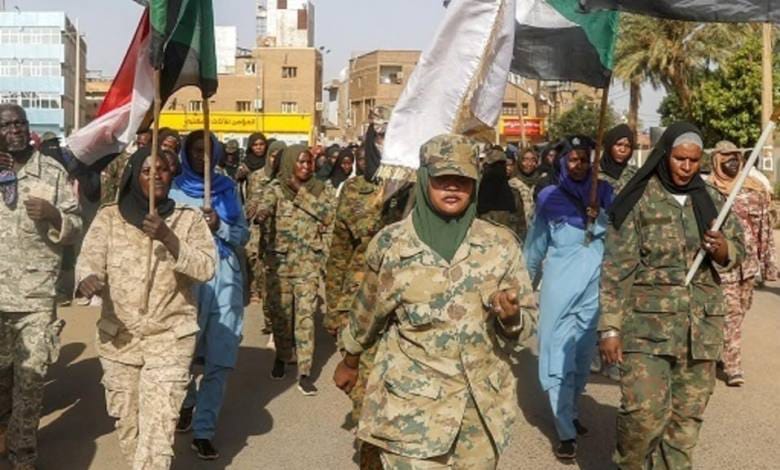
Memory and Stories
Jallalat acquire a special significance in such moments. They are an audible memory that recounts stories of heroism and preserves the heritage of Sudan’s regions and their diverse rhythms within the national consciousness.
The soldier’s voice cannot be separated from the rhythm of his step, just as the battlefield cannot be separated from the beat of drums and the sound of brass instruments. The Jallala is performed collectively, giving the ranks a single voice and a shared rhythm.
Behind that voice, however, lies a much older story—one rooted in collective labour, harvests and nafir (communal cooperation), as well as war songs and chants of courage known to Sudanese communities throughout different historical eras.
These are the Jallalat: moments when enthusiasm becomes melody, history becomes words, and popular memory transforms into a military march.

Collective Labour
Originally, the Jallala was not merely a form of entertainment. It was closely associated with collective labour and nafir, where a shared rhythm helped unite individuals and sustain their effort.
Sudanese communities practised such forms of rhythmic chanting in agriculture and harvesting, as well as in ports, loading operations, cotton ginneries and other forms of labour where rhythm helped organise movement and boost morale.
When this tradition entered military life, it found a natural environment. Soldiers train collectively and require discipline in movement and marching, as well as encouragement during demanding exercises and difficult work.
Thus, the Jallala found its place in the field. It became the voice of the group, led by music and repeated by human voices, synchronised with marching steps, and giving each individual the sense of belonging to a force greater than himself.
Older Than the Modern Army
Long before the establishment of the modern army, Sudanese societies had known warfare, military traditions and heroism—and with them came forms of expression celebrating courage and collective motivation.
From the kingdoms of Kush, Napata and Meroë and the Nubian kingdoms, through Sennar, Darfur and Taqali, and later the Turkish-Egyptian period, the Mahdist era and Anglo-Egyptian rule, warfare remained deeply embedded in popular memory.
Heroes and fighters occupied prominent places in stories and chants. War songs celebrated horsemen, encouraged fighters, recalled victories and preserved the names of figures who earned a lasting place in collective memory.
With the development of military music, some popular songs with regular rhythms became suitable for adaptation into military marches, while those retaining their original lyrics continued to be known as Jallalat.
Wad Al-Sharif and Mendi
From Sultan Ali Dinar of Darfur to Mendi, daughter of Sultan Ajabna, the names of historical figures were transformed into melodies.
Perhaps the most remarkable feature of Sudanese Jallalat is their ability to preserve within them a person, a place or a historical event.
Among the best-known examples is “Wad Al-Sharif Ra’yo Kamil,” a march associated with Sultan Ali Dinar. Its legacy later passed into the Sudan Defence Force and continued to live on within military music.
There is also the march “Mendi Bint Al-Sultan Ajabna,” which carries into the military field the story of a woman’s struggle against colonialism in the Nuba Mountains. Her popular chant was transformed into an inspiring military march.
The musical map extends further to include chants and marches inspired by the heritage of numerous Sudanese communities—from the Shaigiya and Shilluk to the Nuba, and from Kordofan and Darfur to eastern and southern Sudan—reflecting the diversity of cultural environments that shaped the melodies and rhythms of Sudanese military music.
Brass, Drums and Bagpipes
No discussion of Jallalat would be complete without recalling the military music that gave them their distinctive character.
Brass instruments, drums, bagpipes and percussion create the familiar atmosphere of military celebrations, official occasions and training grounds.
Military music is more than a form of ceremonial display. It helps regulate marching steps, raise morale, support training and preserve military traditions and ceremonies.
It has also played a role in preserving and documenting elements of popular heritage by collecting songs and marches drawn from different cultural traditions. In this way, the Army’s Corps of Music became one of the institutions that carried certain popular melodies forward to future generations.
A Book of Memory
Retired military expert and human rights specialist, Lt. Gen. Dr. Jalal Tawer, opens a wide window onto the history of Sudanese Jallalat and military marches, stressing that this heritage is as old as soldiering itself.
Speaking to Al-Karama, Tawer said that the primary function of Jallalat is to create enthusiasm among troops during training and strenuous work.
He noted that the phenomenon is not confined to the military, pointing to its presence in ports, loading operations, cotton ginneries and collective agricultural activities and harvests, particularly nafir, where it serves to unify rhythm and raise morale.
Tawer stressed that military traditions in Sudan are as old as the country’s history. He traced their roots through the kingdoms of Kush, Napata and Meroë, the Nubian kingdoms, Sennar, Darfur and Taqali, followed by the Turkish-Egyptian period, the Mahdist era and Anglo-Egyptian rule.
Those historical periods, he said, produced war songs and chants of courage that celebrated heroes and inspired fighters.
According to Tawer, with the emergence of the modern army in 1925, Jallalat became an important part of Sudanese military marches. Among the best known was “Wad Al-Sharif Ra’yo Kamil,” associated with Sultan Ali Dinar and preserved after the incorporation of the Sultanate’s forces into the Sudan Defence Force.
Perhaps the most significant point in Tawer’s account is that this heritage was never identical across Sudan. Each province and region had its own march reflecting its particular culture and traditions.
There were marches from Kordofan, Bahr El Ghazal, Equatoria, Darfur, Kassala, Northern Sudan and Khartoum.
As the Sudanese Armed Forces developed and became unified, this diverse heritage was gathered under the umbrella of the Army’s Corps of Music, which became a guardian of the memory and cultural heritage of Sudan’s many regions.
Here lies the beautiful paradox of the Jallalat: the institution that brought soldiers into unified ranks also carried within its music the diversity of Sudan itself.
Lt. Gen. Jalal Tawer concluded his remarks by congratulating the Sudanese Armed Forces on their anniversary and their successive victories, praying for victory, peace, security and stability for Sudan.
An Important Conclusion
Whatever the circumstances, the army celebrating its 72nd anniversary is also reviving a musical and cultural heritage shaped over many decades—a heritage that carries within it the voices of Sudan’s different regions, the names of sultans and heroes, and the rhythms of its communities and landscapes.
For this reason, Sudanese Jallalat deserve to be understood as both a military heritage and a form of national folklore.
Perhaps the time has come to establish an organised project to document them—collecting their lyrics, melodies, stories and the occasions in which they were performed, while preserving what remains in the memories of soldiers, veterans and musicians.
What is heard today on training grounds and battlefields may tomorrow become a historical document.
For the Jallalat represent a united Sudan—condensing its long history into a single voice.

Post your comments
Photo of the Week

Khartoum | Sudanow Muslims around the world commemorate the birth of the Prophet Muhammad, peace and blessings be upon him (PBUH), during the month of Rabi’ al-Awwal, recalling a message that transformed human society and emphasized mercy, justice, brotherhood and human dignity. On this occasion, the editorial team of Sudanow Magazine extends its sincere greetings to Musl...
More-

30 August, 2026
Stories from the Heart of the Battlefield From a University of Khartoum Professor to a Vegetable Seller in Cairo
Cairo (Sudanow) In one of Cairo’s neighborhoods, where the stories of passersby intersect with the details of everyday life, the story began with a quiet-faced Sudanese man standing behind a small vegetable stall. He carefully arranged tomatoes and greens, selling them with a smile. Few of those passing by knew that the man they addressed so simply had spent years of his life in lecture halls and scientific research labor...

Contact Us

Address: Sudan News Agency (SUNA) Building, Jamhoria Street, Khartoum - Sudan
Mobile:+249 909220011 / +249 912307547