


Sudan After the War: Three Global Experiences in Reconstruction, Industrialization, and National Security
30 August, 2026
Khartoum (Sudanow)
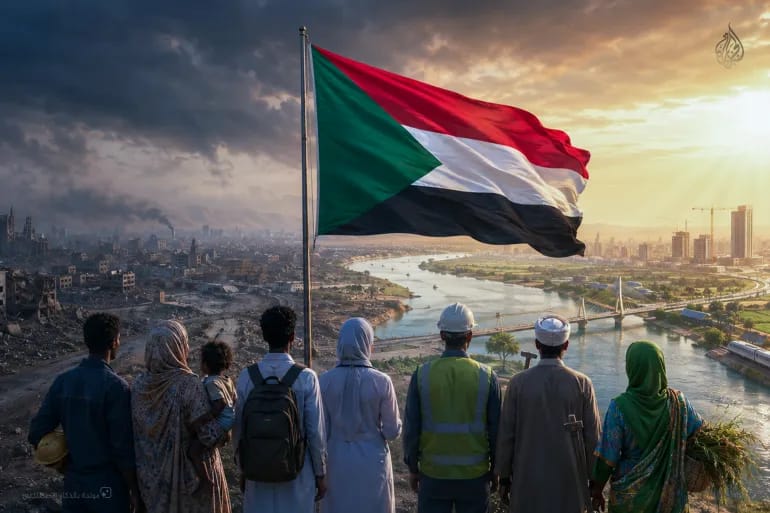
As Sudan enters the post-war phase, the task of reconstruction cannot be reduced to rebuilding what the fighting destroyed. The real challenge lies in rebuilding the state itself, restoring its economic and productive capacity, making effective use of its resources, and redefining the roles and relationships of its institutions in a way that lays stronger foundations for a state capable of recovery, stability, and confronting future challenges.
Against this backdrop, the experience of the Economic Corporation of the Sudanese Armed Forces emerges as one of the issues that deserves calm and serious discussion—not only in terms of the role it played before and during the war, but also with regard to its potential position during the recovery and reconstruction phase.
Dr. Rashid Mohamed Ali Al-Sheikh, Professor of Political Science and International Relations at Sudanese universities, argues in his interview with SUDANOW that Sudan has an opportunity to redefine the concept of national power on the basis of an integrated strategic framework that makes use of its natural resources, as well as its military, technological, and engineering capabilities. He also stresses the importance of drawing lessons from countries that succeeded in turning the aftermath of wars and crises into a starting point for building stronger states.

Three Models, Three Lessons for the Sudanese Army
Dr. Rashid identifies three experiences that Sudan should study: Japan, South Korea, and Egypt, while emphasizing that each developed within its own distinct historical, political, and economic context.
The Japanese experience, he explains, offers an important lesson in transforming the aftermath of war into a national development project, particularly in the fields of economic, technological, and industrial advancement.
South Korea, meanwhile, provides a model for transforming an economy with a predominantly agricultural base into an advanced industrial and technological economy founded on manufacturing and integrated production.
The Egyptian model, he argues, is comparatively closer to Sudan in terms of certain circumstances, resources, and regional conditions. It offers potentially useful lessons, particularly in food security, the development of local resources, and adding value to raw materials through processing and manufacturing industries.
Sudan, he cautions, should not seek to replicate a single model wholesale. Instead, it should develop its own national formula by drawing on the strengths of different experiences: Japanese technology, Korean industrialization, and Egyptian experience in resource management and food security.
From Defense Power to State Power
According to Dr. Rashid, Sudan possesses sufficient resources to combine economic power with defense capabilities. Achieving this, however, requires what he describes as an “integrated strategic state-building” approach.
Under this vision, economic power would become one of the driving forces of national strategy, while the armed forces would retain their fundamental responsibility for protecting national security in its various dimensions.
This would include protecting the country's economic interests and addressing geopolitical and geostrategic challenges, making economic security an integral component of national security.
A strong state, in this conception, is one in which military power is integrated with economic, technological, and political power.
The “Productive Army”: From an Economic Concept to a Strategic Vision
Dr. Rashid presents the concept of the “productive army” as one of the ideas associated with building comprehensive national power. However, he believes that the post-war period requires a reassessment of the concept itself.
In his view, military doctrine may need to evolve beyond the traditional concept of defense toward a broader understanding of national security protection—one that emphasizes preparedness for war as a means of preventing it, while strengthening the state's ability to anticipate risks and threats and respond to them at an early stage.
Economically, he stresses that national industrialization and food security are responsibilities shared by all state institutions. The armed forces can contribute in areas where they possess advanced expertise and capabilities, particularly technology, engineering, logistics, and defense-related industries.
Such participation, however, should take place within the framework of the state's broader economic strategy and should not replace the private sector or civilian institutions.
Raw Materials: Why Does Sudan Export Its Resources at Low Value?
Dr. Rashid highlights one of the fundamental challenges facing the Sudanese economy: the export of resources in their raw form.
He argues that rebuilding the country's export system should be based on adding value to raw materials through processing and manufacturing before export. This would increase economic returns, create employment opportunities, and strengthen national industrial capabilities.
With its vast agricultural, mineral, and water resources, Sudan does not merely need to extract and export its wealth. It needs to build integrated production chains that begin with the resource and end with a higher-value finished product.
In this context, various economic institutions—including the Economic Corporation of the Armed Forces—could play defined roles within a broader national strategy.
Egypt: When the Military Institution Intersects with the Economy
In his assessment of the Egyptian experience, Dr. Rashid notes that the strength of Egypt's military institution has been linked to the country's strategic environment, which has contributed to its involvement in a number of issues related to security, defense, the economy, and foreign policy.
Egypt has also witnessed various forms of cooperation between the private sector and the military establishment in several activities, including manufacturing and food production.
He argues that the distinctive nature of the Egyptian experience is partly rooted in the structure of the Egyptian state and the historical development of its institutions. Consequently, the model cannot simply be transferred to Sudan. Rather, it should be studied carefully and lessons extracted according to the Sudanese context.
The Private Sector: A Partner, Not a Substitute
Dr. Rashid stresses that the post-war period will require genuine partnership between the state, the private sector, and various economic institutions.
The Sudanese economy, emerging from war, will require massive investment and the reactivation of productive sectors. No single institution can shoulder the burden of reconstruction alone.
Regulating the relationship between the Economic Corporation of the Armed Forces and the private sector will therefore be critical, particularly with regard to governance, transparency, and fair competition.
He emphasizes that the exceptional circumstances facing Sudan may require transitional arrangements. Such arrangements, however, should not mean the absence of rules governing economic activity. On the contrary, they could provide an opportunity to rebuild those rules on a clearer and more transparent basis.
Foreign Investment: An Opportunity Conditioned by National Security
Dr. Rashid considers foreign investment a potentially necessary component of the reconstruction phase, but stresses that it requires careful consideration, particularly in areas involving technology, defense industries, and strategic sectors.
During the rebuilding process, Sudan will need foreign capital, expertise, and technology. Yet this should take place within a framework that preserves national decision-making independence and prevents any infringement upon the country's strategic interests.
The equation, in his view, is therefore not about rejecting foreign investment, but about opening the door to it under rules that protect both the economy and national security.
Food Security and Energy: Another Dimension of National Security
Dr. Rashid places food security, energy, industry, and infrastructure among the fundamental components of modern national security.
In its broader conception, national security is increasingly linked to a state's ability to secure the needs of its population, protect its resources, and ensure the continuity of its economy and productive capacity.
The military institution, given its technological and logistical capabilities, could contribute to some of these areas, particularly in emergencies and crises and in projects of strategic importance.
China, Türkiye, and Egypt: Technology as the Gateway to Power
Comparing Sudan's potential trajectory with the experiences of China, Türkiye, and Egypt, Dr. Rashid emphasizes technology as one of the key foundations of national power.
A modern state needs advanced capabilities in communications, surveillance, radar systems, aviation, defense technologies, space technologies, and defense industries.
The experiences of these countries differ according to the size of their resources, the scale of their economies, and the nature of their states. Yet they share a common feature: technology has become an essential component of strategic national power.
For Sudan, developing a national technological and industrial base could therefore become one of the most important pillars upon which the process of rebuilding the state rests.
Reconstruction: Turning Wartime Expertise into an Engine for Peace
Dr. Rashid believes that the engineering, industrial, and logistical capabilities of the military institution could play an important role in reconstruction.
The post-war period will require rapid rehabilitation of infrastructure, restoration of essential services, reopening of roads, repair of facilities, and revival of productive sectors.
At the same time, the years of war have, under necessity, generated expertise in technology, innovation, and logistics that could later be redirected toward peace and reconstruction projects.
Here lies one of Sudan's key opportunities: to transform capabilities developed under the pressures of war into instruments for building during peace.
The Economic Corporation of the Armed Forces: From Meeting Needs to a Broader Role
Returning to the experience of the Economic Corporation of the Armed Forces, Dr. Rashid explains that before the war, part of its activities was linked to meeting certain needs of military personnel, alongside roles associated with local communities and easing some of the cost-of-living pressures on families.
These contributions expanded during the war as needs increased and economic and social conditions changed.
He believes that the post-war phase will create new roles for the corporation, particularly in areas where it possesses advanced capabilities, such as engineering, logistics, technology, and manufacturing.
The real challenge, however, will be determining how these roles can be organized within the broader state system in a way that ensures complementarity with the private sector and civilian institutions while preventing conflicts of jurisdiction and responsibilities.
Sudan Faces an Opportunity to Redefine Power
Ultimately, Dr. Rashid does not believe that the issue of the Economic Corporation of the Armed Forces can be reduced to the question of whether the military institution should engage in economic activity.
The deeper question, in his view, is:
What role should each institution play in the project of rebuilding the state?
Sudan, emerging from war, needs a strategy that goes beyond rebuilding buildings and infrastructure to rebuilding its economy, industry, technological capabilities, food security, energy systems, and infrastructure.
The historic opportunity before Sudan may lie in transforming its vast natural resources into genuine economic power, while using its military, technological, and engineering capabilities to protect that power and support the country's reconstruction—alongside establishing clear rules for governance, transparency, and fair competition.
Reconstruction is therefore not simply a project of rebuilding what was destroyed. It is a project of redefining the state itself: how it produces, how it protects its resources, how it builds its power, and how it transforms its capabilities into influence, stability, and sustainable development.
The most important lesson from the experiences of Japan, South Korea, and Egypt is that states do not rise simply because they possess resources or powerful institutions. They rise when they succeed in directing those resources and institutions toward an integrated national project for building the state.
Post your comments
Photo of the Week

Khartoum | Sudanow Muslims around the world commemorate the birth of the Prophet Muhammad, peace and blessings be upon him (PBUH), during the month of Rabi’ al-Awwal, recalling a message that transformed human society and emphasized mercy, justice, brotherhood and human dignity. On this occasion, the editorial team of Sudanow Magazine extends its sincere greetings to Musl...
More-

30 August, 2026
Stories from the Heart of the Battlefield From a University of Khartoum Professor to a Vegetable Seller in Cairo
Cairo (Sudanow) In one of Cairo’s neighborhoods, where the stories of passersby intersect with the details of everyday life, the story began with a quiet-faced Sudanese man standing behind a small vegetable stall. He carefully arranged tomatoes and greens, selling them with a smile. Few of those passing by knew that the man they addressed so simply had spent years of his life in lecture halls and scientific research labor...

Contact Us

Address: Sudan News Agency (SUNA) Building, Jamhoria Street, Khartoum - Sudan
Mobile:+249 909220011 / +249 912307547