


Stories from the Heart of the Battlefield From a University of Khartoum Professor to a Vegetable Seller in Cairo
30 August, 2026
Cairo (Sudanow)
In one of Cairo’s neighborhoods, where the stories of passersby intersect with the details of everyday life, the story began with a quiet-faced Sudanese man standing behind a small vegetable stall. He carefully arranged tomatoes and greens, selling them with a smile. Few of those passing by knew that the man they addressed so simply had spent years of his life in lecture halls and scientific research laboratories.
He is Professor Hassan Abdel Halim Abdullah Sayed Ahmed, a physics professor at the University of Khartoum, former Dean of the Faculty of Education, and a researcher with a distinguished scientific record in physics and materials science.
But the war that erupted in Sudan forced him, like many other Sudanese, to leave his homeland in search of safety and a means to support his family. He eventually found himself in Cairo, where he chose to work as a vegetable seller—a scene that encapsulates one of the painful consequences of war for scholars, scientists, and highly skilled professionals.
He did not bring his academic titles with him to the market, and his customers did not know him as a professor or a former dean. To them, he was simply “Uncle Hassan,” the quiet man standing behind his stall, doing his work with dignity and beginning his day like any other worker striving to earn a living.
Available academic information indicates that Hassan Abdel Halim is a genuine and well-established scientific figure who was associated with the University of Khartoum for many years. He has published research in physics, materials science, phosphorescent materials, and optical properties. He also served as Dean of the Faculty of Education at the University of Khartoum and was elected President of the University Professors’ Association in February 2023.
This is where the striking contrast that captured the attention of social media users becomes apparent: a man who once stood before students as a professor and led a faculty as its dean later found himself standing among vegetables in Cairo rather than before a blackboard, selling produce instead of discussing the equations of physics with his students.
Yet, whatever the change in profession, it did not diminish the value of the man himself. In the story of “Uncle Hassan,” the vegetable stall does not represent a fall from one social position to another as much as it represents an image of resilience—the ability of a person to rebuild and rearrange life under the pressure of circumstances without surrendering dignity or responsibility toward one’s family.
Social media platforms have circulated another version of the story, claiming that Professor Hassan later applied for an academic position in Germany and was selected to work at one of its universities. According to the widely shared account, he subsequently left Cairo amid an emotional farewell from worshippers and residents of the neighborhood, who only then discovered that the vegetable seller they had known for years was in fact a scientist and university professor.
However, this particular part of the story still requires independent verification. So far, no official announcement has been found identifying the German university involved, nor has an academic webpage been located confirming his appointment. Similarly, no official documentation has been made available confirming the details of his contact with the German embassy or his travel arrangements.
For this reason, the Germany chapter of the story, despite its widespread circulation, remains an unverified account awaiting confirmation from Professor Hassan himself or from an official source capable of establishing its details.
What is certain, however, is that the man himself is not a fleeting character created by social media. He is a Sudanese academic with a documented scientific career who found himself confronting one of the harshest consequences of war: a moment when knowledge, experience, and academic qualifications temporarily shifted from being tools for building the future to memories carried by their owner while searching for a new opportunity in life.
Perhaps that is why his story has touched so many people. It is not simply the story of a professor who became a vegetable seller. It is the story of a human being forced by war to change his position, but not his worth; of a scientist who continued to carry his knowledge and dignity even when the university halls were no longer within reach.
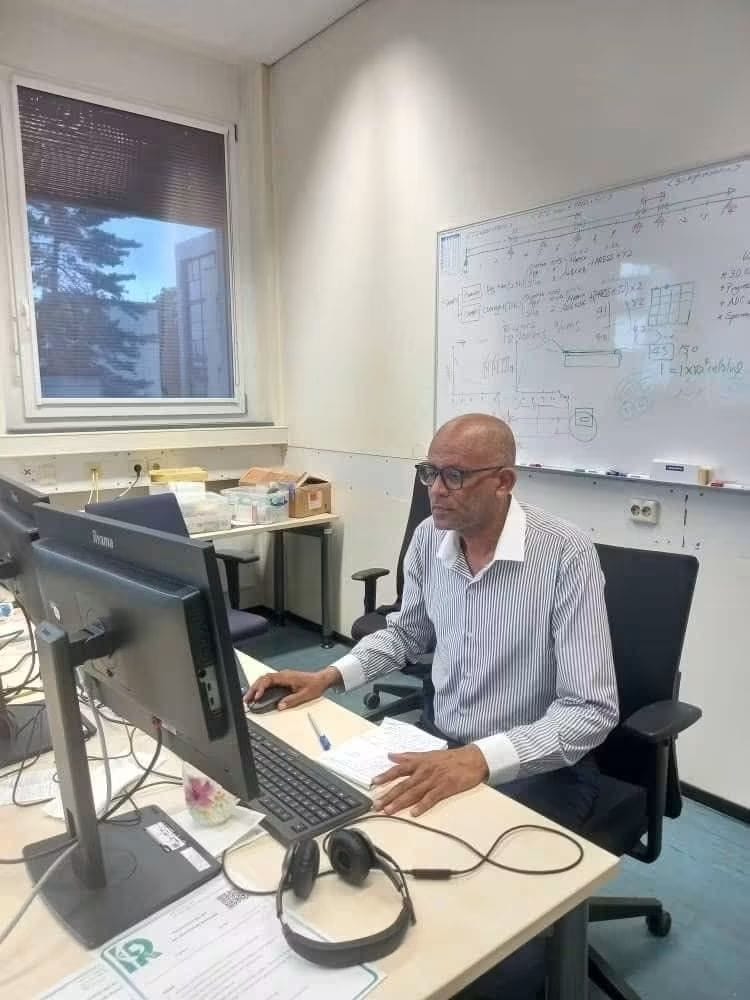
In a country whose institutions have been devastated by war, forcing thousands of academics and professionals into displacement and migration, Hassan Abdel Halim’s story becomes more than an individual tale. It is a reminder of what societies lose when their talents are uprooted from their places—and of what human beings are capable of when they find themselves compelled to begin again.
Professions may change. Places may change. The details of life may be turned upside down.
But a person’s value cannot be reduced to the job they perform or the place where they happen to stand.
Post your comments
Photo of the Week

Khartoum | Sudanow Muslims around the world commemorate the birth of the Prophet Muhammad, peace and blessings be upon him (PBUH), during the month of Rabi’ al-Awwal, recalling a message that transformed human society and emphasized mercy, justice, brotherhood and human dignity. On this occasion, the editorial team of Sudanow Magazine extends its sincere greetings to Musl...
More-
30 August, 2026
Stories from the Heart of the Battlefield From a University of Khartoum Professor to a Vegetable Seller in Cairo
Cairo (Sudanow) In one of Cairo’s neighborhoods, where the stories of passersby intersect with the details of everyday life, the story began with a quiet-faced Sudanese man standing behind a small vegetable stall. He carefully arranged tomatoes and greens, selling them with a smile. Few of those passing by knew that the man they addressed so simply had spent years of his life in lecture halls and scientific research labor...

Contact Us

Address: Sudan News Agency (SUNA) Building, Jamhoria Street, Khartoum - Sudan
Mobile:+249 909220011 / +249 912307547