


Sudan’s New Role
19 November, 2017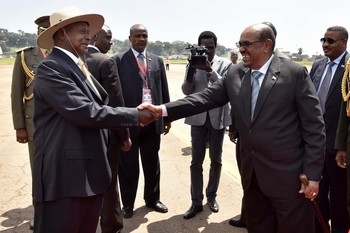
The issue of Sudan’s identity have been brought into new focus of late though from a different angle. Over the past three weeks Khartoum received South Sudan President Salva Kiir, while President Omar Al-Bashir paid a visit to Uganda. During Kiir’s visit a number of bilateral agreements have been signed where border trade was opened and lately Al-Bashir announced that one thousand oil engineers and technicians are seconded to South Sudan to help operate its oil industry. In Uganda Al-Bashir proposed that Khartoum will be hosting a tripartite Sudanese, Ugandan, Arab investment conference to help attract Gulf investments for the two countries.
Aside from a brief period following the 1972 Addis Ababa Accord that put an end to the country’s first civil war, Sudan has been in trouble with its African component, which was part of its ongoing trapped identity issue. As two civil wars raged in the country part of the people saw successive governments adopting pro-Arab stand for the country at the expense of the African half, a feeling that helped in fueling violence and instability as it helped sharpen the feeling of a second class citizens for a good portion of the population.
Then came the Ingaz regime with its ideological fervor and missionary zeal to spread its version of Islam to neighboring countries, a move that helped in isolating the regime, gaining sympathy to those fighting Khartoum and eventually led to the separation of South Sudan. Uganda used to be one of the main critics and its President Yoweri Museveni did not mince his words by describing Khartoum as spearheading an Arab colonization for the south as a first move to spread to neighboring countries.
However, following putting off with the ideological missionary outlook, Sudan started to move back to the realm of an ordinary state, where interests, not ideology, is its diplomacy guide.
And that is where Sudan’s geopolitical position gets an added value. Being part of both the Middle East and Africa geographically and culturally, the country can play an important role as an active contributor, not just a passive bridge between the two worlds.
Last week the transportation minister Makkawi Awad told the parliament that Qatar is planning to develop Port Sudan port and establish the biggest containers port to serve Sudan and its neighbors. That fits well with the needs of the land-locked South Sudan and Uganda, while providing an investment opportunity to Qatar and benefits to the host country, Sudan.
But for such project to achieve its goal and make a strategic shift based on evolving political rapprochement between Sudan neighbors, it needs to be accompanied with two other components: a modern railway and rehabilitating the defunct river transportation. Aside from regional players, such a move can get an international attention in the form of the Chinese bid to reconstruct its new version of the Silk Road, the ambitious plan released four years ago under the motto: One Belt, One Road. With the leadership of Xi Jinping consolidating its power and getting ready to take over a more active leadership at world stage, Sudan needs to further its agenda and work on a long history of mutually beneficial relations between the two countries. After all China’s contribution to establishing oil industry in Sudan, helped it have a show case for the Chinese ability in terms of manufacturing complicated project bearing in mind the speed, the cost and quality of execution.
The improved diplomatic relationship with the five land-locked countries of Ethiopia, Uganda, South Sudan, Chad and Central Africa Republic provides the conducive environment needed to forge ahead with such grandiose projects. In addition the changes taking place in the nearby Gulf States and their continuous seeking for investment opportunities provide a window for the much needed finance as well as that of China. More important it fits with the drive in Africa to go ahead with plans to create a free trade area that should be completed next year, where the continent’s 55 countries join that zone.
What is missing is a well-studied and detailed project covering the three components of the port, the railway and river transport backed by a political will and a strategic approach. For that there is a need for setting up an independent body able to carry out its responsibilities over the years because this is not a short term project.
E N D
SS/AS
Post your comments
Photo of the Week

Dinder – SUNA – SUDANOW As part of international cooperation programs in wildlife conservation and the implementation of international conventions governing wildlife protection in Sudan, the Federal Dinder National Park authorities received a Nile crocodile on the banks of the Dinder River this morning. The crocodile was transported from Jordan to Sudan as part of jo...
More-

30 August, 2026
Stories from the Heart of the Battlefield From a University of Khartoum Professor to a Vegetable Seller in Cairo
Cairo (Sudanow) In one of Cairo’s neighborhoods, where the stories of passersby intersect with the details of everyday life, the story began with a quiet-faced Sudanese man standing behind a small vegetable stall. He carefully arranged tomatoes and greens, selling them with a smile. Few of those passing by knew that the man they addressed so simply had spent years of his life in lecture halls and scientific research labor...

Contact Us

Address: Sudan News Agency (SUNA) Building, Jamhoria Street, Khartoum - Sudan
Mobile:+249 909220011 / +249 912307547