


The Doam: Important Crop, Neglected Fruit
22 April, 2018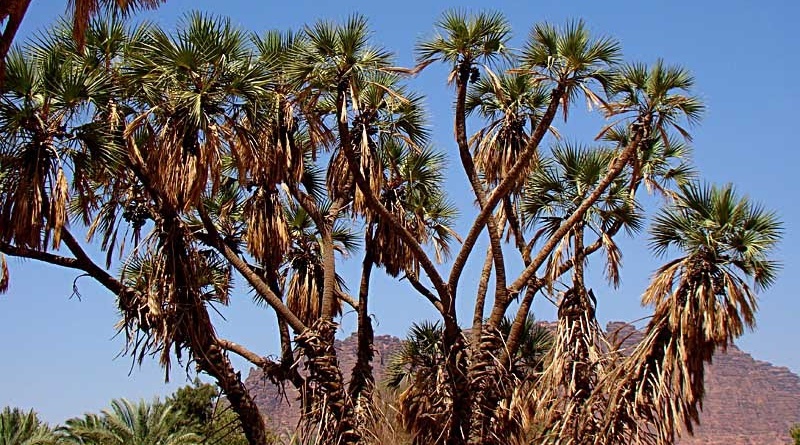
KHARTOUM (Sudanow) - Unlike other trees, the doam palm is gigantically tall. Its leaves are very tough. Regardless, its shadow is just a trace.
The doam is a durable tree that grows on rocky grounds, mountain slopes and along valley and creek sides.
The doam (also written doum and doom) is a genus of palms native to Africa, Madagascar, the Middle East and the Indian subcontinent. It is also known by its scientific name hyphaene thebacia. The doam trees are unusual among palms in having regular naturally branched trunks. Most other palms are single-stemmed from the ground. Its edible and tough fruits are oval in shape.
The doam tree grows wild in most parts of the Sudan. But on some occasions farmers grow them. In this case the nut (seed) inside the fruit is buried in the ground and the farmer keeps irrigating it until it stems up from the ground. The latter process may take a year due to the toughness of the seed skin. Very often the farmers crack the nut before sowing to secure quick growing.
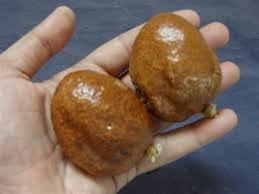
The doan trunk may shoot up to 30 meters. It grows thorny leaves and yields fruits the size of apples or oranges. The fruit is red-brownish, coated in a tough skin. It is the spongy flesh inside that is eaten. Below this lies the fruit’s tough smooth white seed. The doam fruit is sweet and has many nutritional, medical and economic benefits.
Street vendors present the fruit in different forms. Some vendors sell it as it is, while others peel off the hard skin from the fruit. Some sellers pound the fruit and bake it in the form of candies. It can also be soaked in water for sometime and then taken as a delicious juice.
A doam tree can bear 1000 fruits a year. Each fruit weighs 140 grams.
The doam fruit was an important export in the past when its hard seed was used as vegetable ivory and in the making of clothes’ buttons. Sudan had used to manufacture such products in Khartoum and Atbara, but this industry could not resist plastic products. Some plants in Kasala (East) had also used to manufacture animal fodder from doam fruits. The Doam seed is also crushed into powder and manufactured into pastes and paints, with some other chemical additions.
The doam leaves are woven into hay rugs, baskets and trays. Here they are colored to give pleasant shapes.
The doam fruit was found to be useful in the treatment of hypertension and high cholesterol. It is believed to strengthen memory, enhance brain health and fight aging. It is also thought to fight tumors and caner cells multiplication, prostate cancer in particular. It is used in cases of chronic diseases and for cementing health of the heart and veins. In this it is believed to prevent blood clots. It is also believed to increase sperms by increasing the male hormone ‘the testosterone’ and fight impotence. It is also used for hair growth. Here specialists advise the use of doam fruit infusion on daily basis to strengthen the hair and prevent hair fall, thanks to its high content of certain vitamins that enhance hair health. Doam juice is used to treat mouth ulcers, soothe foot pain and heal some skin diseases. They are also used for the treatment of bilharzias, eye diseases and spleen inflammations.
Doan tree trunks are used in house roofing and in the making of doors because they resist white ants that feed on timber.
More research is required to disclose the doam tree ‘s medical and economic benefits.
E N D
YH/AS
Post your comments
Photo of the Week

Cairo (Sudanow) The story began with a chance encounter on the afternoon of the 16th of this month. As I stepped out of my residence in Cairo, I noticed a young Sudanese woman, no older than twenty-four, hurrying through a narrow street crowded with pedestrians. I stepped aside to avoid colliding with her and jokingly remarked, "Take it easy; this is Cairo, not Khartoum." She ap...
More-

28 June, 2026
Stories from the Heart of the Battlefield On the Threshold of Waiting: Stories of Families Searching for Their Missing
Khartoum – Sudanow Wars are not measured solely by the numbers of the wounded and the dead; they are also measured by the silent voids they leave in the hearts of the living. These voids are created by forced absence, when a person becomes an unknown number or a name suspended between hope and despair. As Sudan’s war enters its fourth year, one of its most painful tragedies continues to unfold: the issue of missing persons,...

Contact Us

Address: Sudan News Agency (SUNA) Building, Jamhoria Street, Khartoum - Sudan
Mobile:+249 909220011 / +249 912307547